



The smash concept sounds aggressive, but it is really a smart passing play built on one simple idea: make a defender choose.
One receiver stops short on a hitch route, while another breaks deeper toward the sideline on a corner route.
The quarterback reads the defender between them and throws to the open option.
That is why the smash concept football play is so common at every level of the game. It is easy to understand, but it can still be hard to stop when the timing is right.
In this article, I’ll break down how the routes work, what the quarterback looks for, and how the concept matches up against Cover 2, Cover 3, Cover 4, and man coverage.
What is the Smash Concept?
I like to think of the smash concept as a simple way to put one defender in a bad spot.
The outside receiver usually runs a short hitch, while the inside receiver, often a slot receiver or tight end, breaks toward the sideline on a corner route.
That creates a high-low read. If the defender steps up to cover the hitch, the corner route can open behind them. If the defender drops back, the quarterback can take the short throw.
I’ve seen this concept work so often because the idea is easy to understand, even when the offense changes the route depths or uses different offensive formations.
The details may shift from one playbook to another, but the goal stays the same: give the quarterback a short option, a deeper option, and one clear defender to read.
How the Smash Route Combination Works
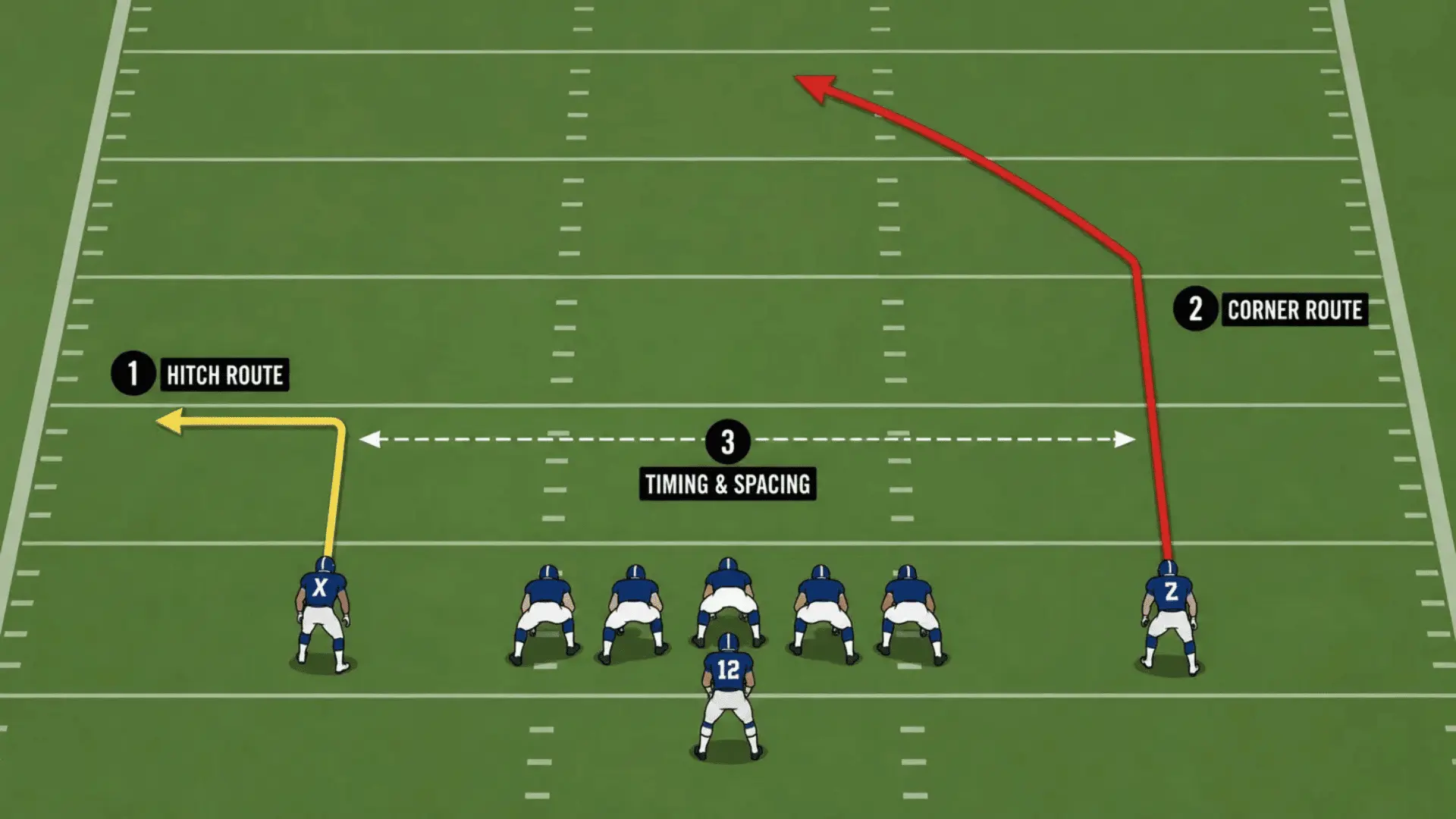
The smash concept works because the two routes attack the same side of the field at different depths.
I find it easiest to read the play from the short route up to the deeper one. The hitch keeps the underneath defender close, while the corner route moves into the space behind them.
When both receivers run their routes at the right depth and pace, the quarterback gets a clear choice. When the spacing is poor, or the throw comes late, that window can close quickly.
| Part of the Concept | How It Works | Key Detail |
|---|---|---|
| Hitch route | The outside receiver pushes upfield, stops, and turns back toward the quarterback. This short route helps hold the defender underneath. | It is often run at about 5 to 7 yards, though the exact depth can change by system. |
| Corner route | The inside receiver runs straight at first, then breaks toward the sideline behind the short defender. | It usually develops around 10 to 15 yards downfield and needs a strong vertical start. |
| Timing and spacing | The quarterback reads the gap between the two routes and throws before the defense can recover. | If the hitch goes too deep or the corner breaks too early, one defender may affect both routes. |
When I charted this play for a staff, the most common breakdown was not the read; it was depth. A hitch that drifts up to nine or ten yards crowds the corner route and lets a single defender play both.
The five-to seven-yard landmark exists for a reason.
How the Quarterback Reads Smash
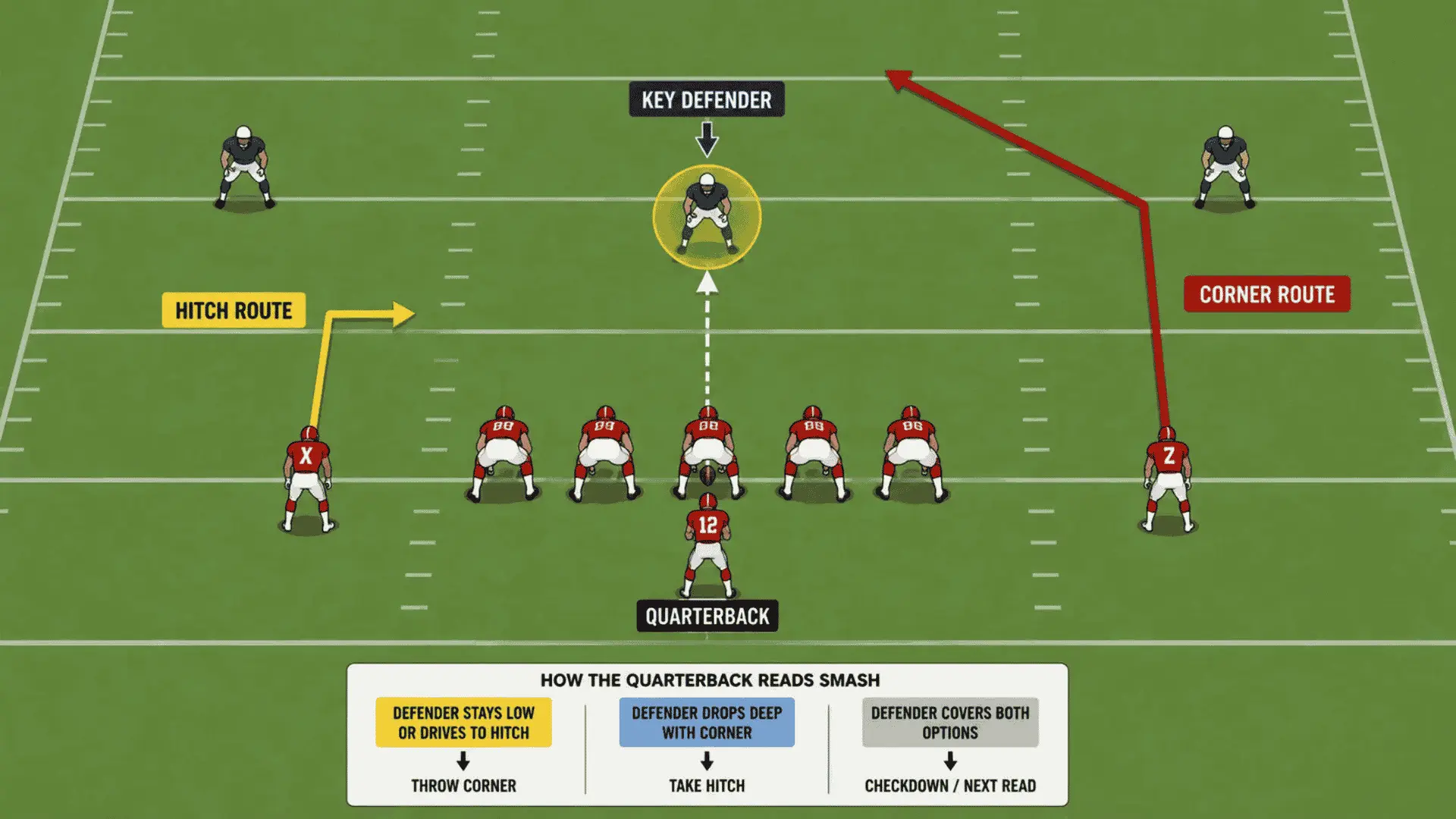
The quarterback begins reading the smash concept before the ball is snapped.
They study the defensive alignment, then confirm the coverage after the snap to decide which route gives the better opportunity.
I like to think of it as reading one defender instead of chasing every receiver on the field. The process becomes much easier when you break it into two simple reads.
The Basic High-Low Read
After the snap, the quarterback focuses on the defender caught between the hitch and corner route. That defender’s first movement usually tells the quarterback where the football should go.
Rather than picking a receiver first, the quarterback reacts to the defender’s decision and throws into the space left open.
When both routes are covered, the safest play is to move on instead of forcing the pass.
| If the Defender… | The Quarterback Should… |
|---|---|
| Stays low or drives toward the hitch | Throw the corner route behind them |
| Drops deeper with the corner route | Take the hitch underneath |
| Covers both options | Move to the checkdown or next read |
Who is the Key Defender?
The key defender changes with the defensive coverage, so the quarterback cannot expect to read the same player every time.
In one play, it may be the cornerback, while on another it could be the curl-flat defender or another underneath defender.
I find it easier to remember the defender’s responsibility than their position, because different defenses assign that role to different players.
- Cover 2: The cornerback is often the primary read.
- Cover 3: The curl-flat defender usually becomes the key read.
- Other coverages: A nickel defender, linebacker, or safety may fill that role depending on the defensive call.
Pre-snap motion can help a quarterback identify man or zone tendencies before confirming the coverage after the snap.
How Smash Works Against Different Coverages
Smash does not create the same opening against every defense.
The quarterback must identify how defenders cover the short and deep areas, then adjust the read rather than expecting the corner route to open automatically.
Each coverage changes which defender matters most and where the safer throw may appear.
1. Smash Against Cover 2
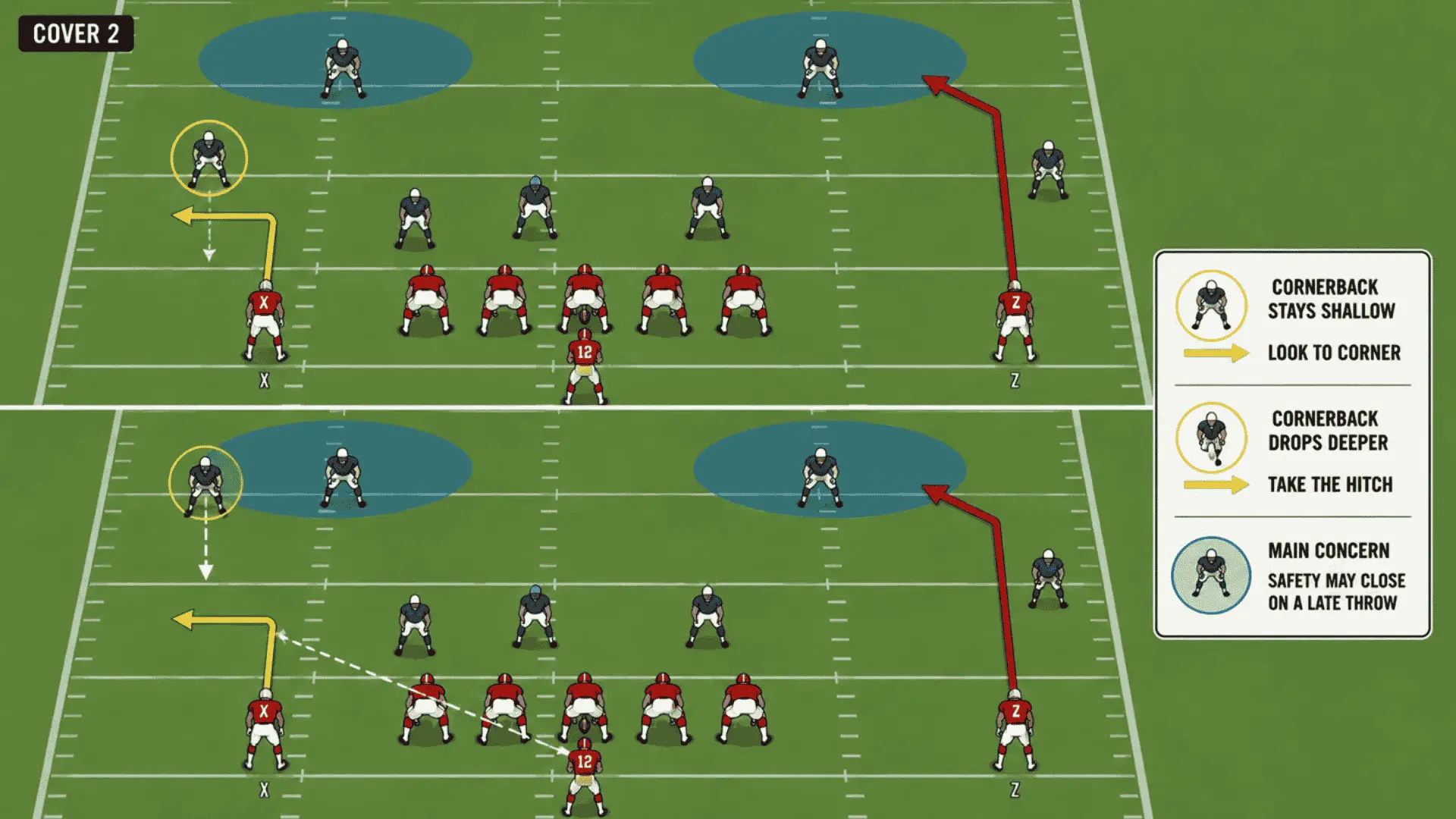
Cover 2 is the classic matchup for Smash because the cornerback usually protects the short outside area while the safety covers the deep half.
That places the cornerback between the hitch and corner route. If they stay low, the corner route can open behind them. If they sink, the quarterback can throw the hitch underneath.
- Cornerback stays shallow: Look to the corner route.
- Cornerback drops deeper: Take the hitch.
- Main concern: The safety may close on a late throw.
2. Smash Against Cover 3
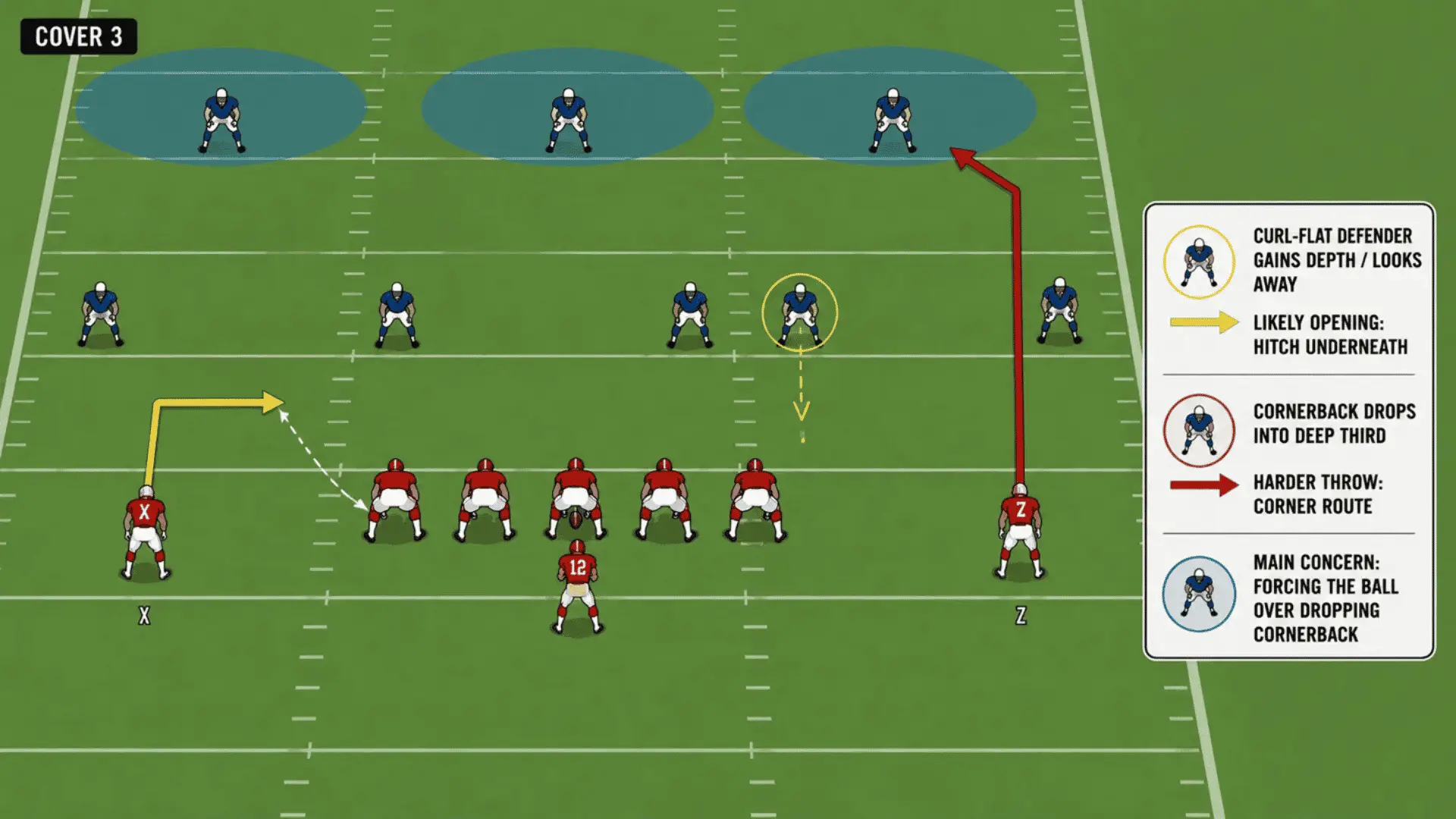
Against Cover 3, the cornerback often drops into the deep third, which can take away the corner route. The quarterback may instead read the curl-flat defender underneath.
If the curl-flat defender gains depth or turns attention toward another receiver, the hitch may open underneath. The quarterback must still account for the cornerback dropping into the deep third.
This becomes a more patient read because the deeper route usually has less room against the outside cornerback.
- Likely opening: Hitch underneath.
- Harder throw: Corner route into the deep third.
- Main concern: Forcing the ball over a dropping cornerback.
3. Smash Against Cover 4
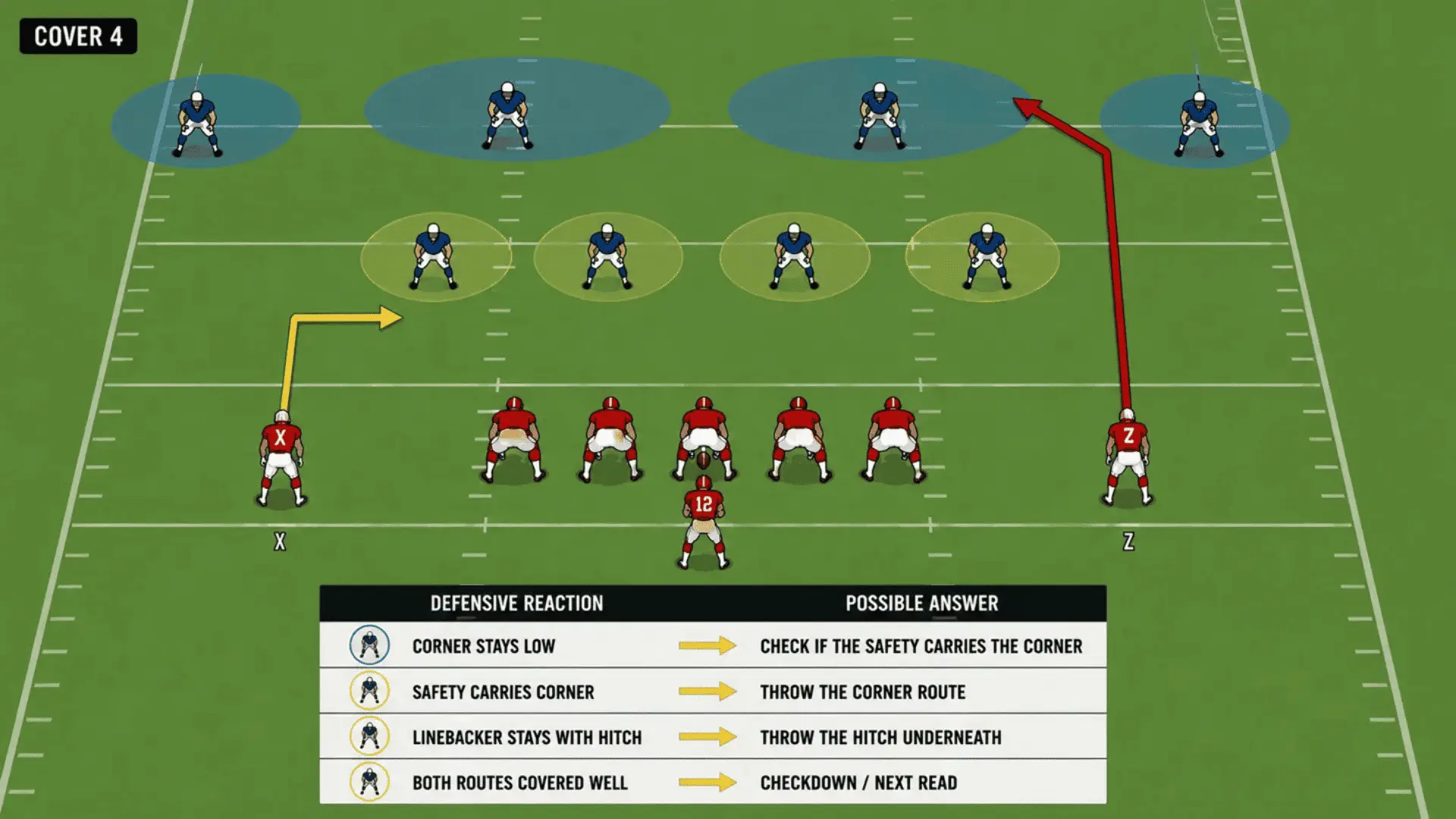
Cover 4 can make Smash harder because the cornerback and safety may divide the two routes through zone responsibilities or match rules.
One defender can stay near the hitch while another carries the corner route.
The quarterback must recognize if the defense is playing a spot drop zone or matching receivers before deciding where to go.
| Defensive Reaction | Possible Answer |
|---|---|
| Corner stays low | Check if the safety carries the corner |
| Both routes matched | Move to another option |
4. Smash Against Man Coverage
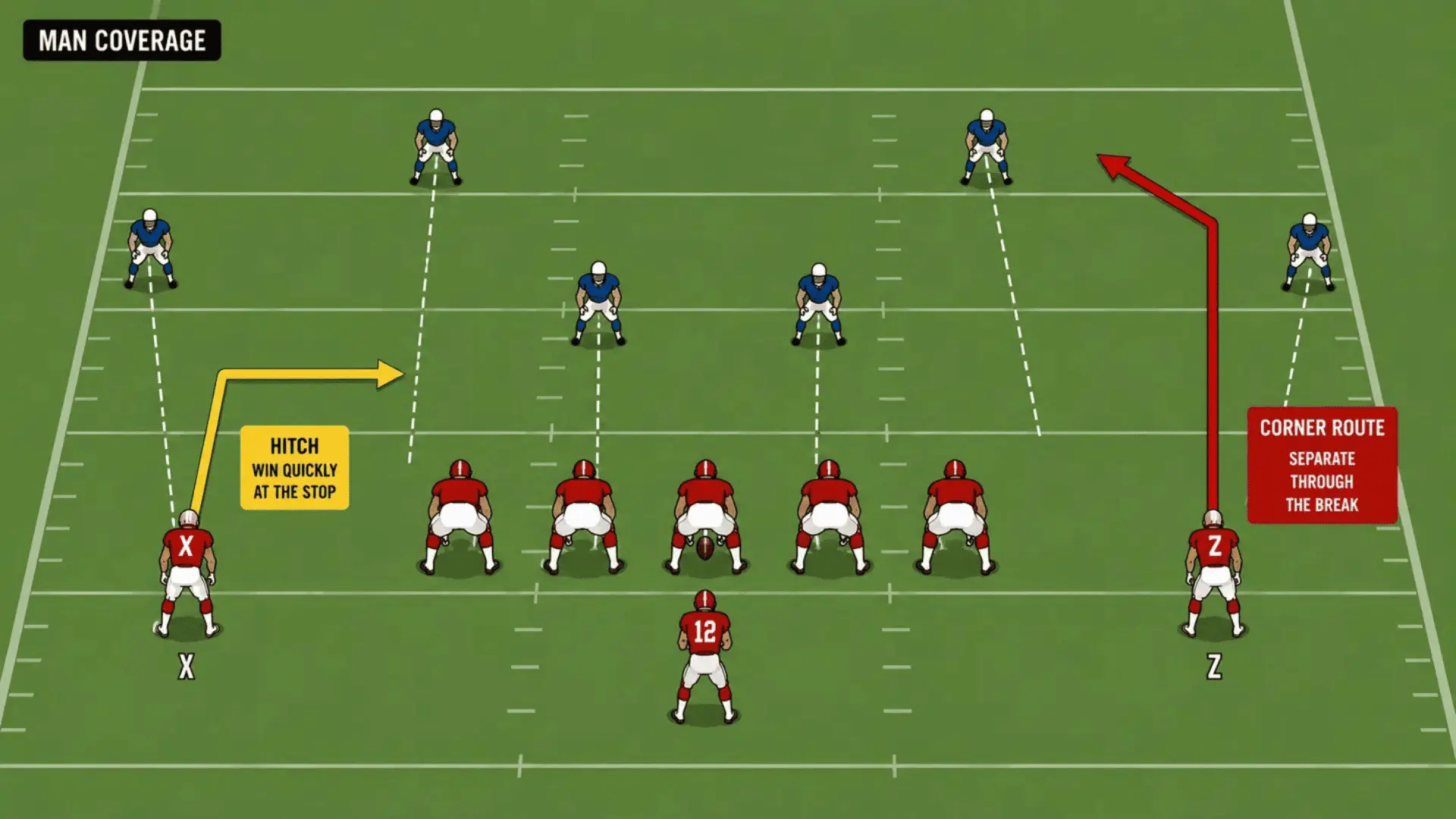
Smash can still work against man coverage, but the high-low conflict becomes less important because defenders follow individual receivers.
The hitch receiver must create space at the stop point, while the corner-route receiver must separate at the break.
The quarterback reads the matchups rather than a single zone defender and should avoid waiting for a coverage conflict that may never materialize.
- Hitch: Win quickly at the stop.
- Corner route: Separate through the break.
- Main concern: Tight coverage on both routes.
The key differences are easier to compare once you see how each coverage changes the read, the likely opening, and the main danger.
| Coverage | Main Read | Likely Opportunity | Main Risk |
|---|---|---|---|
| Cover 2 | Read the cornerback between the short and deep routes | The corner route may open behind a shallow corner, while the hitch is available if the corner sinks | A deep safety can close quickly if the throw is late or floats toward the sideline |
| Cover 3 | Read the curl-flat defender while checking the deep-third cornerback | The hitch is often the safer option underneath the deep coverage | The corner route may enter the outside cornerback’s deep-third zone |
| Cover 4 | Read the flat defender and safety while identifying any match rules | The quarterback may need to adjust based on which defender carries each route | Two defenders can divide the hitch and corner route without creating a clear high-low conflict |
| Man Coverage | Judge each receiver’s matchup and separation | Either route can work if the receiver wins cleanly against their defender | The zone conflict disappears, so both receivers may remain tightly covered |
Common Smash Variations
The basic Smash concept stays the same, but offenses can adjust the formation, route order, and receiver responsibilities for different situations.
From an on-field viewing perspective, these changes can make the same core concept look like a completely different play.
Here are some of the most common ways offenses adapt the Smash concept.
- Mirrored Smash: Both sides of the formation run the Smash concept at the same time. This gives the quarterback the freedom to read either side based on the defensive alignment before or after the snap.
- Trips Smash: Three receivers line up on one side, creating more route combinations. The extra receiver can stretch the defense horizontally or provide an additional underneath option if the primary read is covered.
- Switch Smash: The receivers exchange releases immediately after the snap, then run their assigned routes. This can confuse defenders, especially in man coverage, and create cleaner separation.
- Red-Zone Smash: The routes are shortened to fit the limited space near the goal line. The concept still creates a high-low read, but the quarterback must make a quicker decision because the field is compressed.
- Play-Action Smash: The quarterback fakes a running play before throwing. The fake may draw linebackers forward, creating more room behind them for the corner route or another intermediate throw.
- Motion Smash: A receiver goes in motion before the snap to reveal the defensive coverage or force defenders to adjust their positioning. That information can help the quarterback identify the best read before the play begins.
Smash vs. Stick and Sail
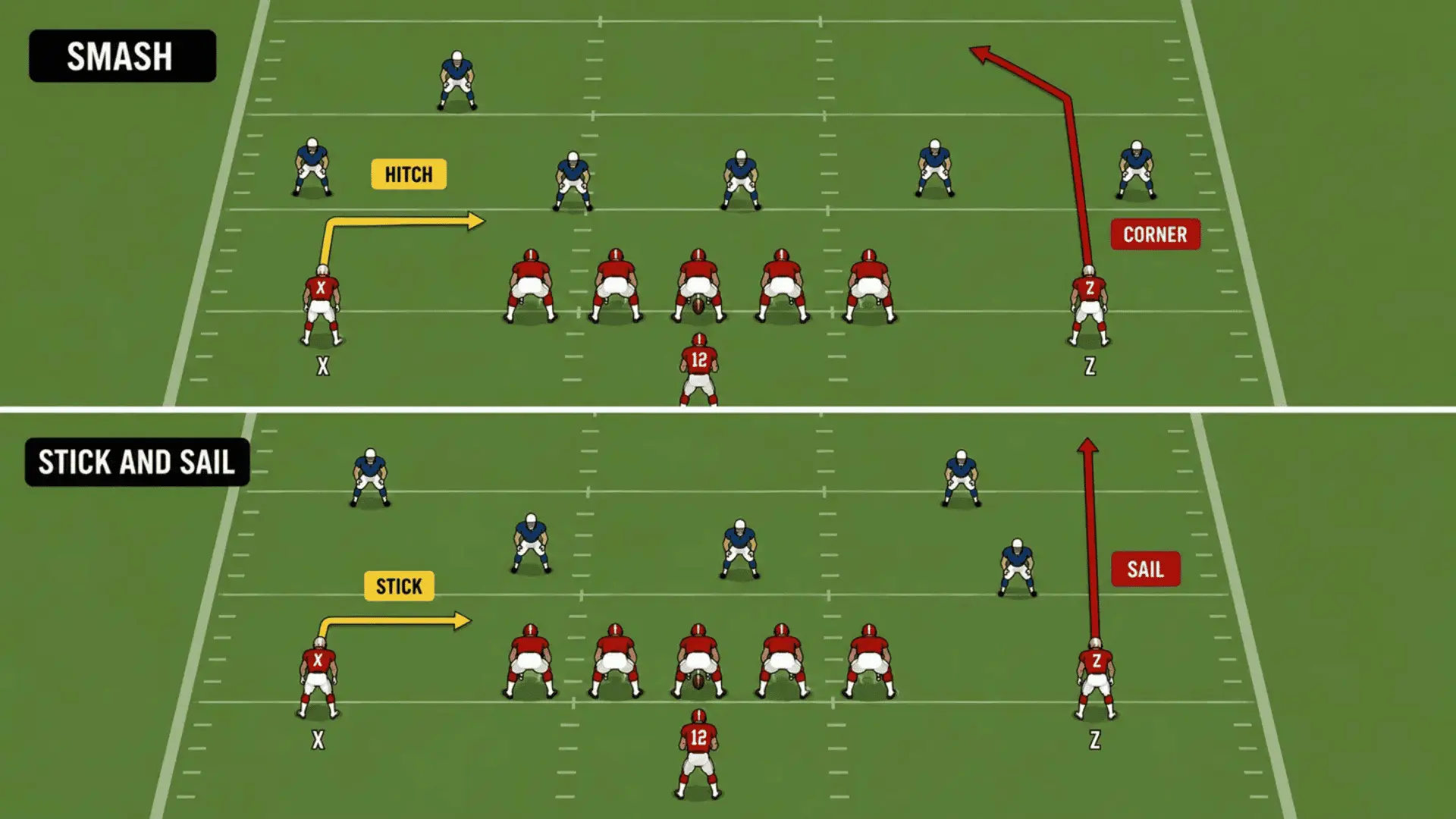
Smash, Stick, and Sail all attack the outside of the field, so it is easy to confuse them at first. The biggest difference is how they stress the defense.
I like to think of Smash as a two-level read, Stick as a quick underneath concept, and Sail as a three-level stretch that gives the quarterback more vertical options.
Understanding these differences makes it much easier to recognize each concept during a game.
| Concept | Main Routes | How It Attacks the Defense | Quarterback’s Primary Read | Best Situation | Main Difference |
|---|---|---|---|---|---|
| Smash | Hitch and corner | Creates a two-level stretch by forcing one defender to choose between a short and deep route near the sideline | Read the defender between the hitch and the corner route | Medium-yardage situations, red zone, Cover 2 | Relies on a high-low read with two receivers attacking different depths |
| Stick | Stick and flat | Puts immediate pressure on the defenders underneath with two quick-developing routes | Read the defender underneath and throw quickly | Short-yardage plays and quick passing situations | Focuses on fast, underneath completions rather than attacking deep space |
| Sail | Flat, out, and corner | Creates a three-level stretch with receivers attacking short, intermediate, and deep areas along one sideline | Progress from short to deep based on the coverage | Play-action passes and intermediate-to-deep passing concepts | Uses three route levels instead of two, making the defense cover more vertical space |
I find that remembering how many levels each concept attacks is the easiest way to tell them apart.
Smash stretches two levels, Stick stays underneath, and Sail adds a third route to put even more pressure on the defense along the sideline.
Common Mistakes to Avoid
Smash looks simple on paper, but small errors can ruin the spacing and timing that make it work. I often see the play break down because one route is off by only a few yards, or the quarterback waits too long.
These are the mistakes that cause the most trouble.
- Running the hitch too deep: A deep hitch brings the short route too close to the corner route. That shrinks the throwing window and may allow one defender to affect both receivers.
- Breaking the corner route too early: An early break prevents the route from forcing the defense to play vertically. The receiver should sell the vertical stem first, then break toward the sideline at the planned depth.
- Reading the wrong defender: The key defender changes with the coverage. If the quarterback watches the wrong player, they may miss the open route or throw into a defender’s zone.
- Throwing the corner route late: The corner route must usually be thrown before the receiver reaches the sideline. A late pass gives the safety or outside corner time to close.
- Forcing the ball: Smash will not create a clean opening on every snap. If both routes are covered, the quarterback should take the checkdown, move to the next read, or protect the ball.
At the End
The smash concept has remained popular because it gives the quarterback a simple way to put pressure on the defense without overcomplicating the read.
Once you understand how the hitch and corner routes work together, it becomes much easier to recognize the concept during a game and understand why quarterbacks make certain decisions.
I have always found that breaking the play into small steps makes it much less intimidating, even if you are new to football strategy.
The next time you watch a game, keep an eye on how offenses attack the sideline and how defenders react. You may start spotting the smash concept before the play is even over.
If this guide helped you understand the concept, share your thoughts or tell us which football play you’d like to learn about next.
Frequently Asked Questions
Can Every Team Use the Smash Concept?
Yes. The Smash concept is flexible enough for high school, college, and professional offenses. Teams simply adjust the formations, route depths, and personnel to match their offensive system.
Why is the Smash Concept Difficult to Defend?
The concept forces defenders to protect two passing windows at different depths. Even disciplined defenses must react quickly, giving the quarterback a chance to throw into the space created by their movement.
Which Offensive Personnel Fits Smash Best?
Smash works with many personnel groups, but it is especially effective with a reliable slot receiver or tight end who can run a sharp corner route and create separation near the sideline.
Can the Smash Concept be Used Near Midfield?
Absolutely. Although many people associate Smash with the red zone, offenses also use it between the 20-yard lines to gain steady yardage, attack zone coverage, and move the chains.