



Football broadcasts often mention terms like “11 personnel” just before the snap, as if everyone already knows what they mean.
If you’ve paused for a second trying to decode that number, you’re asking the right question. It isn’t a play call or a formation.
Instead, it’s a quick way to identify the offensive players on the field, and it tells you a lot about what an offense might do next. Once you understand 11 personnel, game analysis, coaching videos, and play breakdowns become much easier to follow.
In this article, you’ll learn exactly what 11 personnel means, how the numbering system works, why NFL teams rely on it so often, how it compares with other personnel groupings, and how to recognize it during a game.
What 11 Personnel Means in Football
11 personnel in football means an offense has 1 running back, 1 tight end, and 3 wide receivers on the field.
I have found that once you understand those two numbers, football becomes much easier to follow because they quickly tell you which skill players are on the field before the snap.
The first digit represents the number of running backs, while the second represents the number of tight ends.
Since offenses use five eligible skill players, the remaining three are wide receivers.
This personnel grouping gives teams a balanced mix of running and passing options, which is why it has become one of the most common offensive packages in modern football.
How the Numbering Code Works
Football uses a simple numbering system to identify who is on the field, not where they line up.
Instead of listing every skill position before each play, coaches and broadcasters use a two-digit code that quickly tells everyone the offensive personnel package.
Once I learned how to read those two numbers, terms like “11 personnel” and “12 personnel“ stopped sounding like play calls and started making perfect sense.
Here’s how the code works:
| Number | What It Represents |
|---|---|
| First Digit | Number of running backs (RBs) |
| Second Digit | Number of tight ends (TEs) |
| Remaining Eligible Players | Wide receivers (WRs) |
Since an offense has five eligible skill players, you can always figure out the number of wide receivers by subtracting the running backs and tight ends from five.
| Personnel | RB | TE | WR | What it Usually Tells You |
|---|---|---|---|---|
| 11 Personnel | 1 | 1 | 3 | Balanced run and pass options |
| 12 Personnel | 1 | 2 | 2 | More size for blocking and play action |
For example, if you hear an announcer say a team is in 12 personnel, you already know there is one running back and two tight ends on the field.
That leaves two wide receivers as the remaining eligible skill players.
The same numbering system is used in the NFL, college football, and high school football, so once you understand it, you’ll be able to recognize personnel groupings at almost any level of the game.
11 Personnel vs. Every Other Common Grouping
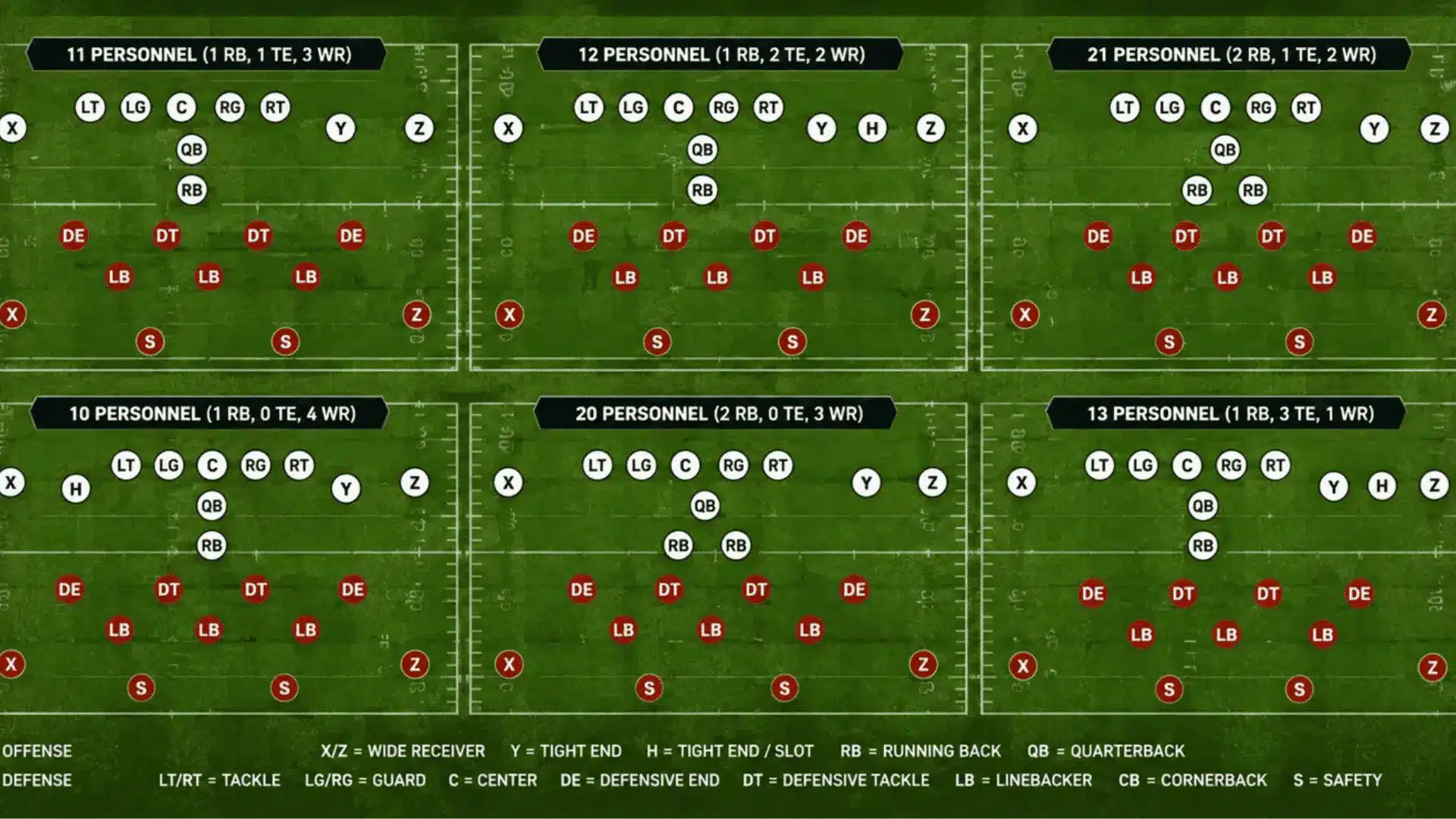
No single personnel package works for every situation. Each grouping changes the balance between speed, receiving options, and blocking support, giving offenses different ways to attack a defense.
| Personnel | Running Backs | Tight Ends | Wide Receivers | Primary Purpose |
|---|---|---|---|---|
| 10 Personnel | 1 | 0 | 4 | Maximize passing options and spread the defense. |
| 11 Personnel | 1 | 1 | 3 | Balance the passing game with a reliable run threat. |
| 12 Personnel | 1 | 2 | 2 | Add blocking strength while keeping play-action effective. |
| 13 Personnel | 1 | 3 | 1 | Create heavy formations for power runs and short-yardage situations. |
| 21 Personnel | 2 | 1 | 2 | Use a fullback or second back to strengthen the running game. |
| 22 Personnel | 2 | 2 | 1 | Build maximum size for goal-line and power-running plays. |
Among these groupings, 11 personnel sit in the middle of the run-pass spectrum.
It offers more receiving threats than heavier packages like 12-, 13-, 21-, and 22-personnel packages, while still keeping a tight end and a running back on the field to support the run game.
Compared with 10 personnel, it gives offenses greater balance, allowing them to switch between runs, passes, and play-action without substituting players.
How to Spot 11 Personnel While Watching a Game
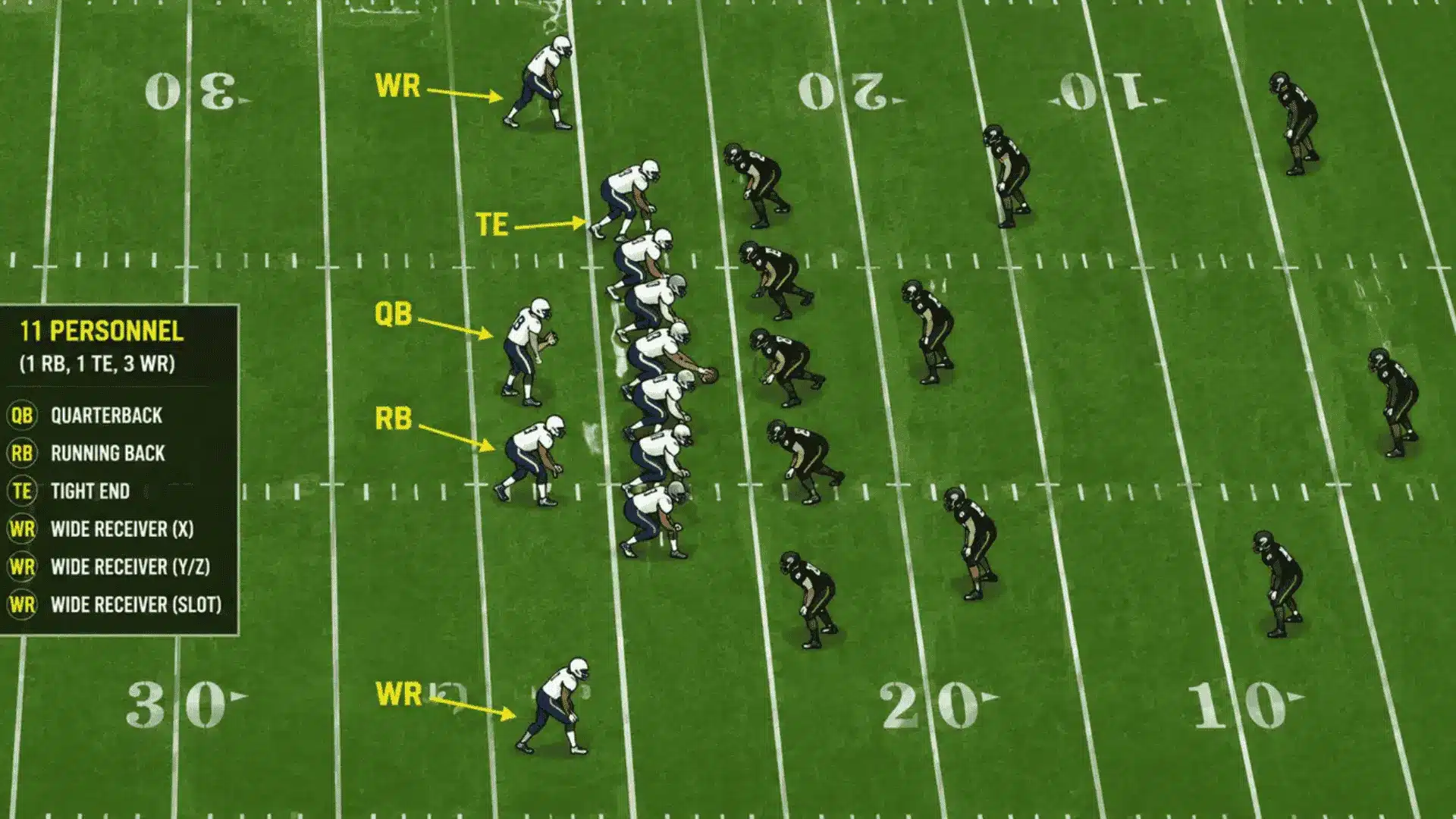
Once you know the code, spotting 11 personnel becomes a simple pre-snap habit. Instead of watching only the quarterback, quickly count the skill players first. Look for:
- 1 running back lined up beside, behind, or near the quarterback.
- 1 tight end attached to the line, flexed into the slot, or moving across the formation.
- 3 wide receivers spread outside, stacked, bunched, or aligned tight to the formation.
The formation may look wide and spread out, or compact, with receivers close to the line.
That is why alignment alone can be misleading. A tight end can split out like a receiver, and a running back can motion wide before the snap.
For casual viewers, this makes broadcasts and film breakdowns easier to follow because personnel tell you what the offense can threaten before the play even starts.
Why Teams Run it and Who’s Running it Best Right Now
Teams run 11 personnel because it gives them answers without changing players.
Three wide receivers stretch the defense horizontally and vertically, while the running back and tight end keep runs, play action, screens, and protection calls alive from the same look.
That flexibility is why many offenses still treat it as a base package rather than a situational wrinkle.
In 2025, ESPN’s personnel grouping review reported that the Cowboys led the NFL in 11 personnel snaps and also ranked best in that grouping, with 101.80 EPA and 6.6 yards per play.
The Ravens used it the least. Heading into 2026, the Bills are worth watching after producing 79 explosive plays from 11 personnel.
Fun Fact: The Bills led the NFL with 79 explosive plays from 11 personnel in 2025, making them a team to watch in 2026.
How Defenses Match Up Against 11 Personnel
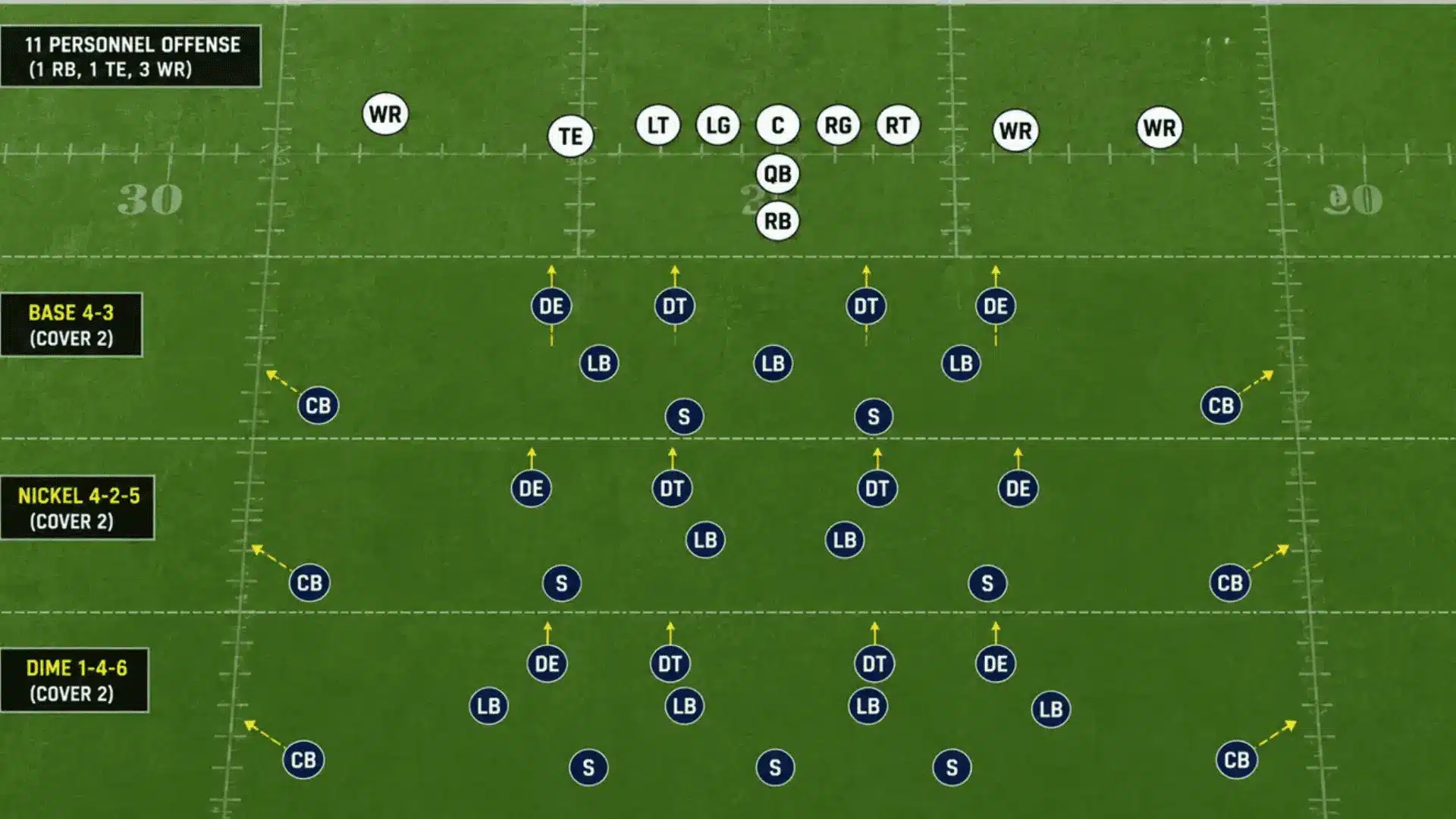
When an offense puts 1 running back, 1 tight end, and 3 receivers on the field, the defense has to match the receivers first without giving up easy runs inside.
That is why the counter usually starts with nickel personnel.
- The defense adds a fifth defensive back.
Nickel gives the defense one more coverage player for the slot receiver, which is important because 11 personnel usually creates three-receiver looks. - One linebacker usually leaves the field.
This helps coverage, but it can make the defense lighter against inside runs, screens, and blocks from the tight end. - The tight end decides how hard the matchup becomes.
If he is mainly a blocker, nickel can still hold up. If he can run routes, the defense has to choose between size and coverage. - That choice is the whole problem for the defense.
Go smaller, and the offense may run. Go bigger, and the offense may throw against slower defenders.
Is 11 Personnel Losing Ground? The 2025–2026 Shift
Not exactly; offenses are just getting smarter.
Instead of ditching 11 personnel, teams are mixing in heavier looks like 12-, 13-, and 21-personnel to attack defenses that live in nickel coverage.
The Rams helped push this shift, driving 13 personnel to 1,845 plays league-wide in 2025, the most in a single season since ESPN started tracking the stat in 2007.
That trend showed up on the biggest stage too, as the Patriots and Seahawks both leaned on heavier packages on their way to Super Bowl LX.
The takeaway is simple: 11 personnel still runs the show for most offenses, but teams are adding bigger groupings to create fresh matchup problems instead of leaning on one look all game.
Final Thoughts
Learning 11 personnel is one of the quickest ways to understand what an offense is trying to accomplish before the ball is snapped.
I have found that once you recognize the 1 running back, 1 tight end, and 3 wide receivers on the field, the game becomes much easier to read.
You can better understand why a team chooses certain plays, how the defense responds, and what matchups each side is trying to create.
The numbers stop feeling like football jargon and start becoming useful clues.
The next time you watch a game, try counting the skill players before every snap instead of waiting for the replay.
Which team do you think uses 11 personnel most effectively, and why? Share your thoughts in the comments.
Frequently Asked Questions
Can an Offense Change Formation Without Changing Personnel?
Yes. The same 11 personnel can line up in trips, bunch, empty, or under-center formations without substituting any players.
Does the 11 Personnel Limit Play Calling?
No. Teams can run inside zone, deep passes, screens, bootlegs, and play action from 11 personnel, making it one of football’s most flexible personnel groupings.
Why Do Defenses Substitute Against 11 Personnel?
Defenses often substitute to match offensive speed, improve pass coverage, and avoid leaving linebackers isolated against quicker slot receivers.
Which Positions Usually Benefit Most From 11 Personnel?
Slot receivers, athletic tight ends, and versatile running backs often thrive because the grouping creates more space and favorable one-on-one matchups.