

Who understands the importance of the game clock better than I do? Having been on the field as a match official, I know that every second counts and that the clock plays a much bigger role in a football game than simply keeping track of time.
An NFL game has 60 minutes of official playing time, divided into four 15-minute quarters. However, the full viewing time is usually around three hours.
College games use the same 60 minutes and often run longer, while most high school games finish in about two to two and a half hours.
The exact duration depends on clock stoppages, replay reviews, scoring plays, and overtime.
Let me break down the four quarters, what happens during breaks, and how NFL, college, and high school game durations compare.
How Long is a Football Game in the NFL?
The NFL splits its 60 minutes into four 15-minute quarters, but the televised NFL game duration is closer to three hours.
Watching takes longer because the clock stops for certain plays, teams use timeouts, officials review decisions, and television broadcasts include commercial breaks.
A standard NFL halftime lasts 13 minutes, giving players time to rest and coaches time to discuss their plans for the second half. The NFL can change this interval for specific games, such as the Super Bowl.
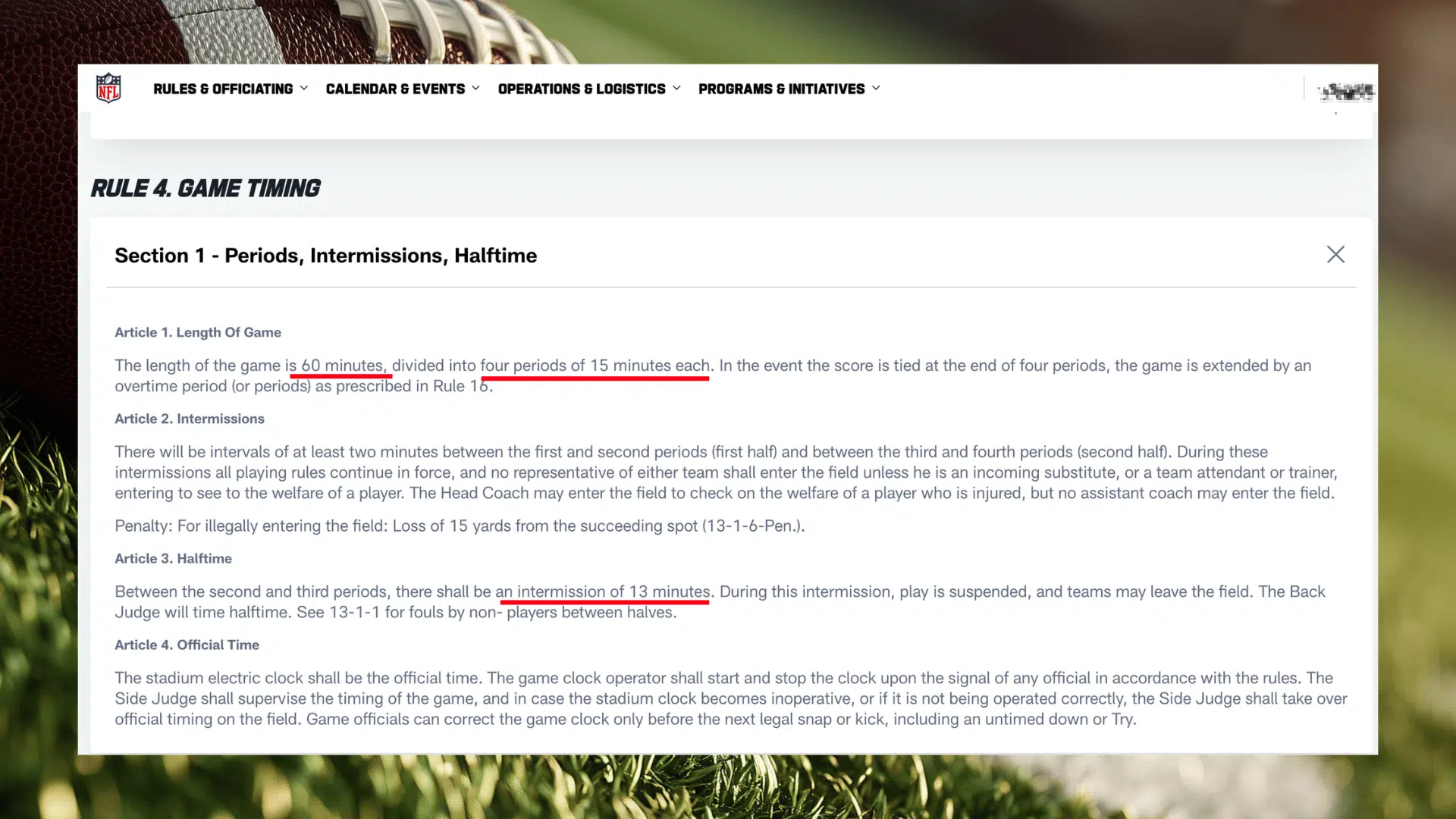
Source: NFL Rulebook
Time division of a standard NFL game at a glance!
Part of the Game | Official Duration |
|---|---|
First quarter | 15 minutes |
Second quarter | 15 minutes |
Halftime | 13 minutes * |
Third quarter | 15 minutes |
Fourth quarter | 15 minutes |
Total playing time | 60 minutes |
Typical broadcast length | About 3 hours |
* Halftime is a break between the two halves, so its 13 minutes are not included in the 60 minutes of official playing time. Special arrangements may apply to certain games.
How Much Actual Playing Time is There in a Football Game?
Far less than 60 minutes. A 2010 WSJ analysis of NFL broadcasts found about 11 minutes of action per game, counting only the time the ball was live.
The game clock can continue running between plays while players return to position, receive instructions, and prepare for the next snap.
The main types of game time are:
Official Game Time: The 60 minutes shown on the NFL game clock.
Ball-in-Play Time: Time when the ball is actively involved in a play.
Stoppage Time: Periods when the game clock is stopped.
Broadcast Time: The full viewing period, including halftime, commercials, and other breaks.
Does Game Duration Differ Between NFL, College, and High School Football?
Yes, game duration differs significantly between high school, college, and the NFL. Clock rules, halftime length, overtime formats, and the number of TV breaks all differ.
I’ve covered the game duration for each game; have a look!
1. NFL Game Duration
NFL regulation lasts up to 60 minutes, with a 13-minute halftime.
In the regular season, a tied game goes to one 10-minute overtime period, and the game can still end in a tie. In the playoffs, teams keep playing until one wins.
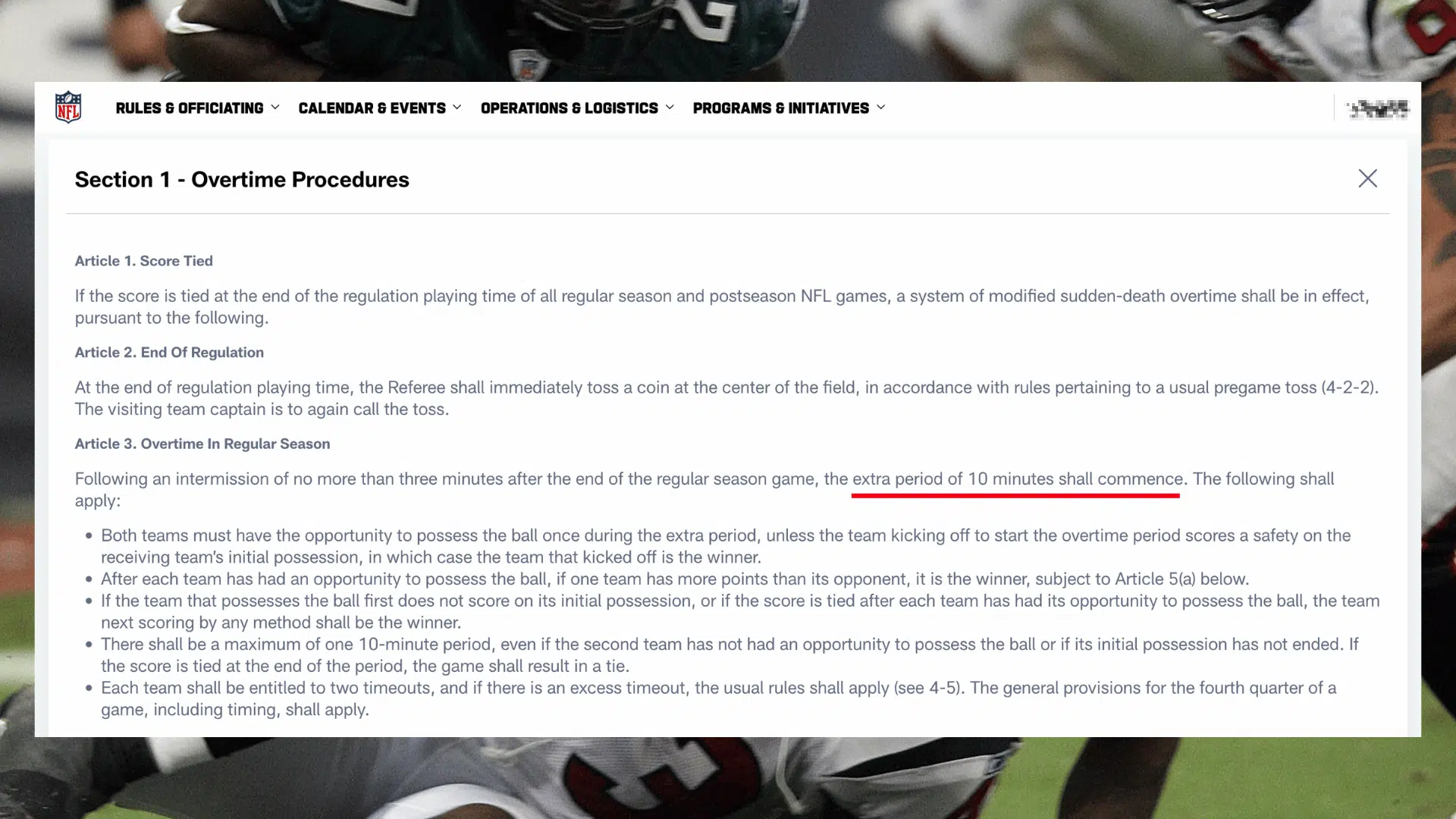
With TV breaks, most regular-season games fill about a three-hour broadcast window.
2. College Football Game Duration
College football also has four 15-minute quarters, for 60 minutes of regulation game time.
Under NCAA rules, the standard halftime interval for a regular-season game is 20 minutes, although the schools can agree to shorten it before the game.
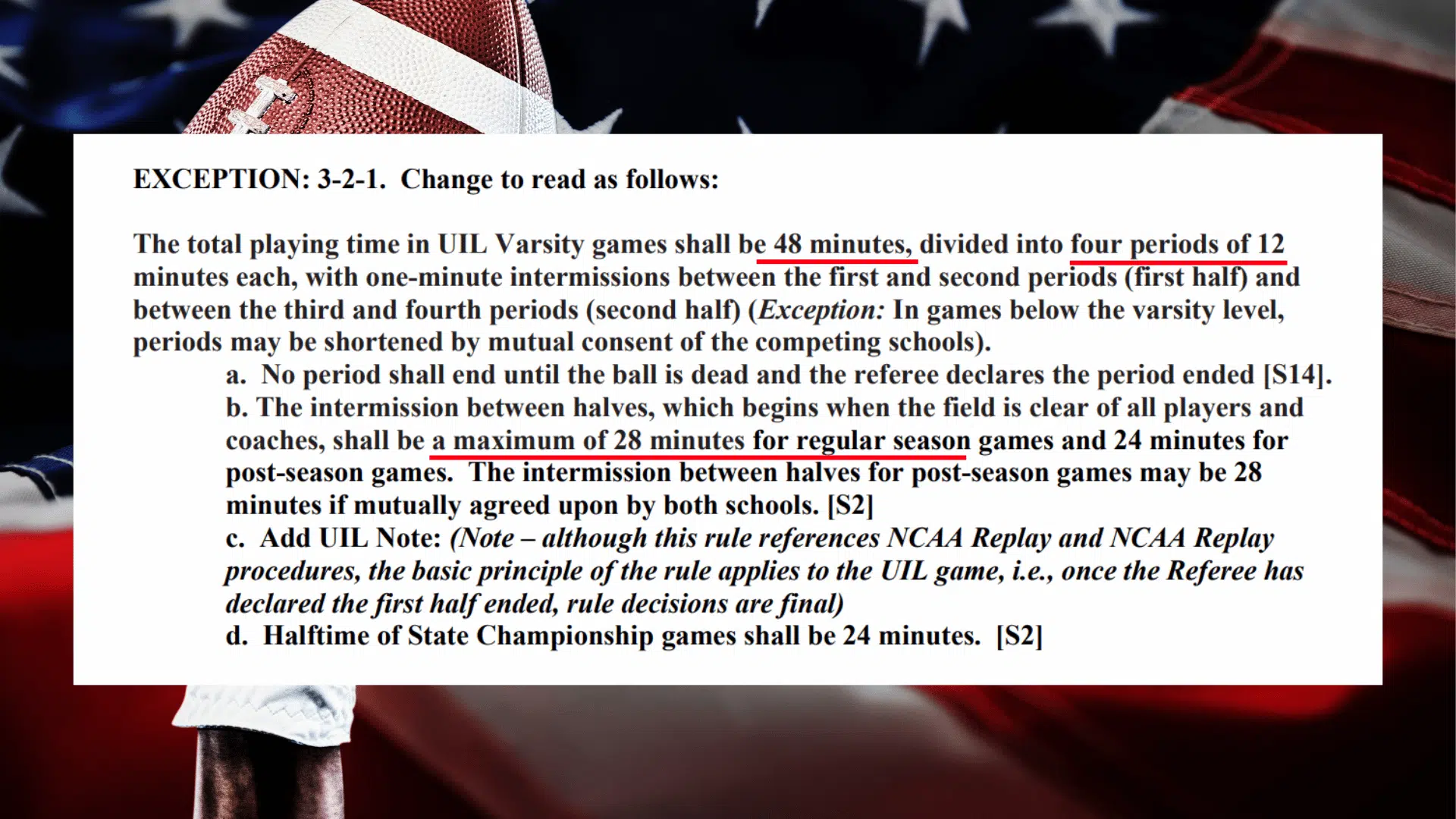
Source: NCAA Rulebook
The breaks between the first and second quarters and the third and fourth quarters are normally one minute, but broadcast timeouts can extend them.
Since 2023, the clock no longer stops after a first down except in the last two minutes of each half. If the score is tied after four quarters, each team gets a possession from the opponent’s 25-yard line, and this repeats until one team leads.
Games with fewer TV timeouts, including many FCS games, usually finish sooner than nationally televised games.
3. High School Football Game Duration
Standard high school varsity games use four 12-minute quarters, giving them 48 minutes of regulation game time. The NFHS provides the national rules framework, but state associations and individual competition regulations can set certain timing details, including halftime arrangements.
Some states or competitions may use different quarter lengths, so check the local rules before treating 48 minutes as universal.
Texas, for example, plays high school football under NCAA-based rules set by the UIL.
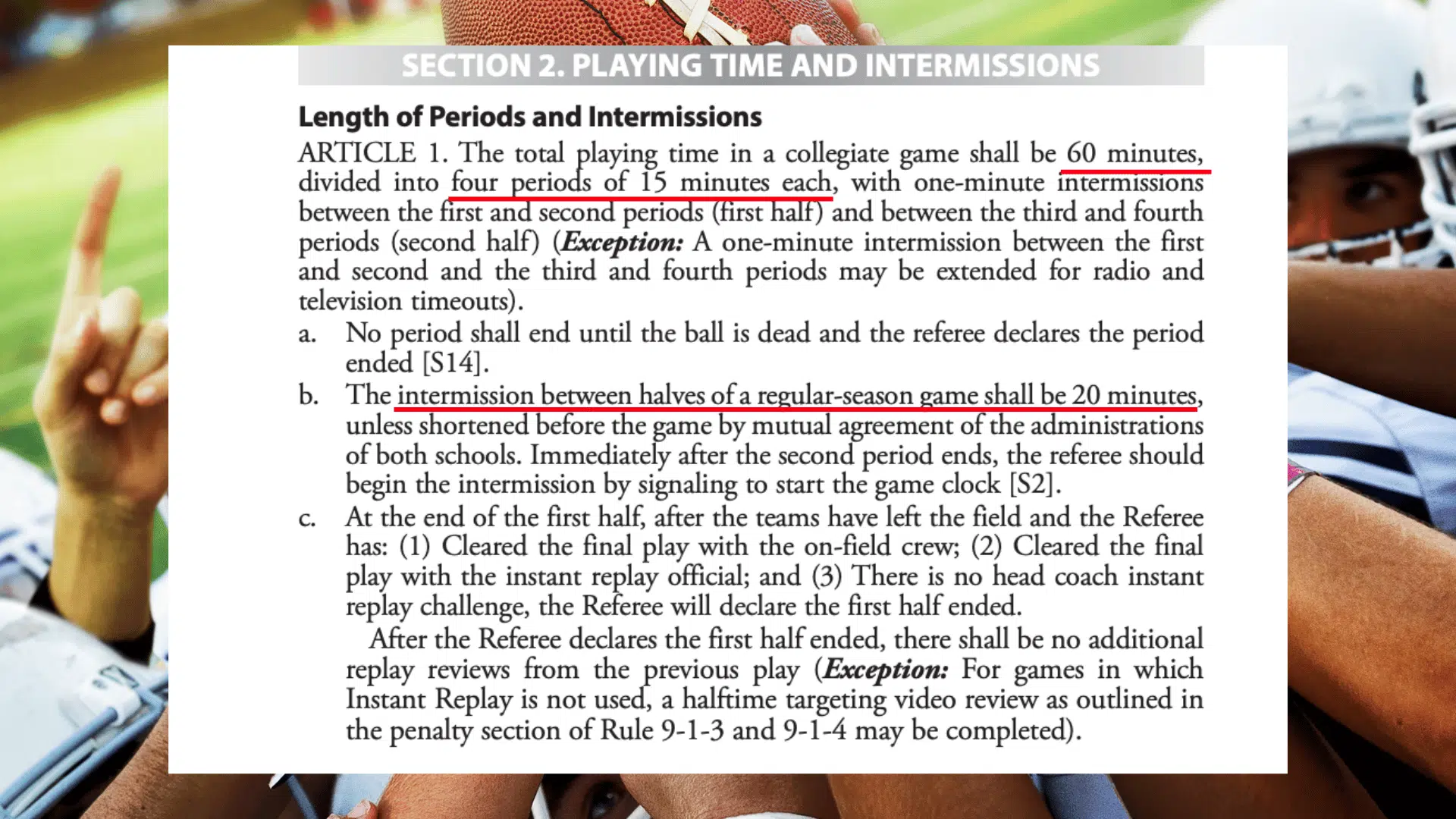
Because most high school games have few or no TV breaks, they usually finish in about two to two and a half hours.
Football Duration at a Glance!
Football Level | Quarter Length | Total Regulation Game Time | Standard Halftime | Overtime | Typical Real Time |
|---|---|---|---|---|---|
NFL | 15 minutes | 60 minutes | 13 minutes | One 10-minute period (regular season) | About 3 hours |
College | 15 minutes | 60 minutes | 20 minutes | Possessions from the 25-yard line | Up to schools to decide |
High school | Commonly 12 minutes | Commonly 48 minutes | Varies by state | Set by state rules | About 2 to 2.5 hours |
Note: These figures describe regulation game time, not the full time spent watching. Clock stoppages, television breaks, reviews, and overtime can make any game last longer. Overtime rules also differ between the NFL, college, and high school football.
Super Bowl and Other Special Games Playing Duration
The Super Bowl runs longer than a regular-season game, mainly because of the halftime show. The break stretches well past a normal halftime (about 30 minutes, but it depends on the musical performance and stage/setup teardown), and the broadcast carries more commercial time.
Playoff games can also run long. Unlike the regular season, playoff games can’t end in a tie, so overtime continues until one team wins.
Prime-time games keep the same 60 minutes. Their TV windows are set by the broadcaster, so check the listed end time if you are planning around a late kickoff
What Can Make a Football Game Last Longer than Usual?
The main factors that can extend a football game include:
Commercial Breaks: TV timeouts follow scores, changes of possession, and some team timeouts. A fan count of 2025 season broadcasts found GEICO among the 10 most frequent advertisers for every team tracked, followed by Verizon and Progressive. Four of the top six brands sold insurance: GEICO, Progressive, Allstate and State Farm.
Incomplete Passes and Out-of-Bounds Plays: Both stop the clock. In the NFL, the clock restarts after an out-of-bounds play once the ball is spotted, except late in each half.
Two-Minute Warning: The NFL stops the clock automatically when two minutes remain in the second and fourth quarters.
Team Timeouts: Each team gets three timeouts per half in the NFL.
Replay Reviews and Challenges: Play pauses until officials confirm or reverse the call.
Injuries and Penalties: Play stops, injuries get attention, or officials enforce yardage.
Weather Delays: Lightning suspends play. High school and college games commonly wait 30 minutes after the last nearby strike.
Overtime: A tie after four quarters adds up to 10 more clock minutes in the NFL regular season.
Frequently Asked Questions
Who Stops and Starts the Game Clock?
Officials control the game clock through signals that the clock operator follows. They also manage stoppages caused by timeouts, incomplete passes, and fouls like a false start.
How Long is an NFL Season?
The regular season runs 18 weeks, and each team plays 17 games with one bye week. The playoffs follow in January and end with the Super Bowl in February.
How Long Before Kickoff Should You Arrive at an NFL Game?
Most NFL stadiums open their gates about two hours (120 minutes) before kickoff. Arrive early for security lines, and leave extra time after the game for traffic.