



After years of working around soccer matches and officiating on the field, I’ve learned that soccer field dimensions are not as fixed as many people think.
A full-size soccer field can vary in length and width, as long as it stays within the limitations set by the Laws of the Game.
Under the Laws of the Game, a full-size adult field can measure 100 to 130 yards long and 50 to 100 yards wide. International matches use a smaller permitted range of 110 to 120 yards long and 70 to 80 yards wide.
During my years officiating matches, field measurements were more than numbers on a diagram. Correct markings affect restarts, penalties, referee decisions, positioning, and match safety.
I’ve explained everything about the official soccer field dimensions, the length of a soccer field in yards, a comparison of youth and adult football fields, and measurements for the penalty area, goal area, center circle, and more.
Let’s start!
Soccer Field Dimensions Explained in 18 Seconds
Before looking at each field marking in detail, here is a quick overview of the main soccer field measurements.
- Adult Field Length: 100–130 yards
- Adult Field Width: 50–100 yards
- Common Professional Field: About 115 × 74 yards
- Penalty Area Depth: 18 yards
- Penalty Area Width: About 44 yards
- Goal Area Depth: 6 yards
- Goal Area Width: About 20 yards
- Penalty Mark: 12 yards from the goal line
- Center Circle Radius: 10 yards
- Goal Width: 8 yards
- Goal Height: 8 feet
The overall field length and width can vary, but many internal field markings stay the same size.
What are the Official Soccer Field Dimensions?
Official soccer field dimensions are given as a range rather than one fixed size.
According to Law 1 of the IFAB Laws of the Game, the touchline can measure 100 to 130 yards. The goal line can measure 50 to 100 yards. The touchline must always be longer than the goal line.
| Measurement | Minimum | Maximum |
|---|---|---|
| Field Length | 100 yards | 130 yards |
| Field Width | 50 yards | 100 yards |
| Field Length in Meters | 90 meters | 120 meters |
| Field Width in Meters | 45 meters | 90 meters |
| Note! Two properly approved soccer fields can have different dimensions and still be legal. | ||
Length of a Soccer Field
The length of a soccer field in yards ranges from 100 to 130 yards for regular adult matches. For international matches, the allowed length is narrower, at 110 to 120 yards.
The length is measured along the touchline, which is the longer boundary running from one end of the field to the other.
This range explains why one stadium may appear longer than another. A competition can choose its own approved dimensions as long as they stay within the rules for that level of play.
Width of a Soccer Field
A regulation adult soccer field can measure 50 to 100 yards wide. For international matches, the permitted width is 70 to 80 yards. Width is measured along the goal line, running from one touchline to the other.
The broad range does not mean professional clubs can choose any width for every competition. Individual leagues, tournaments, and governing bodies may set tighter field requirements.
Did you know width can affect how a game feels? A wider field can create more room on the wings, while a narrower field can place players closer together and reduce open space.
What is the Standard Professional Soccer Field Size?
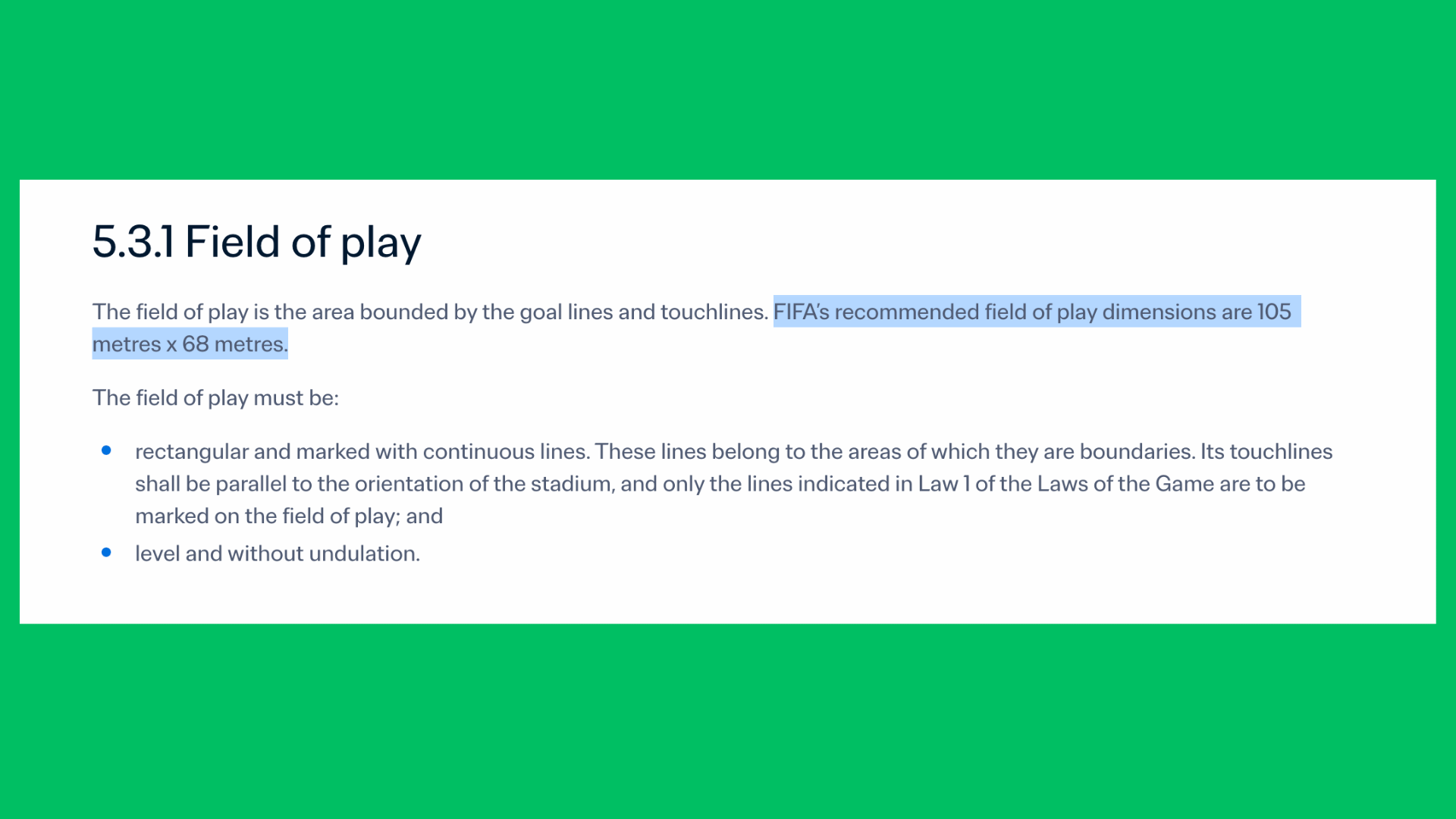
Many major professional stadiums use a field measuring about 105 meters by 68 meters, or roughly 115 yards by 74 yards. FIFA recommends 105 × 68 meters for the field of play in its stadium guidelines.
This is why 105 × 68 meters often appears online as the “standard soccer field size.” It is a common professional benchmark, but it should not be mistaken for the only legal size.
A useful distinction! Legal field range and common professional field size are not the same thing.
The Main Soccer Field Markings and Measurements
The outer dimensions can vary, but several important markings use fixed measurements. Law 1 sets the dimensions for the goal area, penalty area, penalty mark, center circle, corner area, and goals.
These lines matter because they determine where certain restarts take place and where special goalkeeper and penalty rules apply.
1. Touchlines

The touchlines are the two longer boundary lines running along each side of the field. For adult soccer, they can measure 100 to 130 yards. For international matches, they measure 110 to 120 yards.
When the entire ball crosses a touchline, play usually restarts with a throw-in for the opposing team. The ball must completely cross the line before it is considered out of play.
2. Goal Lines

Goal lines are the shorter boundaries at each end of the field. General adult fields can have goal lines measuring 50 to 100 yards. International-match goal lines must measure 70 to 80 yards.
The goals are placed at the center of these lines. A goal is awarded only after the whole ball passes completely over the goal line, between the goalposts and beneath the crossbar, assuming no offense has occurred.
3. Halfway Line and Center Circle

The halfway line runs from the midpoint of one touchline to the midpoint of the opposite touchline, dividing the soccer field into two equal halves.
A center mark sits at the exact midpoint of this line, surrounded by a circle with a 10-yard radius.
During kickoff, opposing players must stay outside the center circle until the ball is put into play. The circle remains the same size even when the overall field dimensions vary.
4. Corner Area

Each corner of the field contains a quarter-circle known as the corner arc. The corner area has a radius of one yard from the corner flagpost. The ball must be placed within this corner area when a corner kick is taken.
Moving the ball noticeably outside the permitted corner area can lead the referee to require the kick to be retaken from the correct position.
5. Penalty Area or 18-Yard Box

The penalty area is commonly called the 18-yard box. Two lines begin 18 yards from the inside of each goalpost and extend 18 yards into the field before being connected by a line parallel to the goal line.
Because a regulation adult goal is eight yards wide, the entire penalty area is about 44 yards wide and 18 yards deep. The goalkeeper receives special handling rights within this area.
6. Goal Area or 6-Yard Box

The goal area is also called the 6-yard box. It extends six yards out from the goal line and six yards from each goalpost.
With a standard eight-yard-wide goal, the full box is about 20 yards wide and 6 yards deep. The name can be confusing because the box itself is not six yards wide.
The six-yard measurement refers to how far it extends from the goal line and goalposts.
7. Penalty Mark and Penalty Arc

The penalty spot is 12 yards from the goal line, directly in front of the center of the goal. A curved line, called the penalty arc, sits outside the penalty area.
During a penalty kick, other players must stay at least 10 yards from the penalty mark.
Worth knowing! The arc is not part of the penalty area, so it does not change where the goalkeeper can use their hands.
8. Extra Spacing
A soccer facility needs extra space beyond the field lines for player safety and reducing injury risks around the field, officials, staff, warm-ups, and equipment.
FIFA recommends at least 3 meters of clear, flat run-off space around primary training pitches.
However, requirements can differ by competition, so I recommend checking the relevant league or governing body rules before marking or building a field.
Youth vs School and College vs International Soccer Field Dimensions
Here’s a table showing field length and width across different levels, where age, competition rules, and the number of players on a soccer team can influence the field setup.
Have a look!
| Level | Field Length | Field Width | Key Detail |
|---|---|---|---|
| Youth Soccer | 25–120 yards | 20–75 yards | Field size increases with the player’s age |
| School & College Soccer | About 100–120 yards | About 55–80 yards | Most use full-size fields within competition rules |
| International Soccer | 110–120 yards | 70–80 yards | Uses the stricter international field size range |
Note: High school & college soccer can follow field standards set by their own governing organizations, so their requirements should not automatically be treated as identical to professional or international soccer.
In the United States, NCAA soccer has its own playing rules and official field diagrams. The NCAA publishes dedicated soccer rule books for collegiate competition. Rules may also be revised between seasons.
Who Takes the Soccer Field Measurements?
Soccer field measurements are generally handled by grounds staff, facility managers,or competition organizers before a match. When marking the field, they must follow the measurement rules set by the relevant governing body.
According to IFAB, measurements are taken from the outside edge of the lines because the lines are part of the areas they mark. This matters when checking the size of the penalty area, goal area, touchlines, and other field markings.
All field lines must be the same width and cannot exceed 5 inches (12 centimeters). The goal lines must also be the same width as the goalposts and crossbar.
For referees, these markings are important because the lines themselves count as part of the area they surround.
Final Verdict
Soccer field dimensions are easier to understand once the legal range is separated from the size commonly seen in professional stadiums.
A full-size adult field can be 100 to 130 yards long and 50 to 100 yards wide, while international fields have tighter limits of 110 to 120 yards by 70 to 80 yards.
Many elite stadiums use a field close to FIFA’s recommended 105 × 68 meters, but that is not the only permitted size.
Knowing the measurements of the 18-yard box, 6-yard box, center circle, penalty mark, and goals also makes match rules much easier to follow.
Have you played or watched matches on fields that seemed noticeably larger or smaller? Share your experience or field-measuring tips in the comments.
Frequently Asked Questions
Is a Soccer Field Bigger than an American Football Field?
A soccer field can be longer and much wider. Soccer allows varying field dimensions, while an American football playing field has fixed basic dimensions.
Why is the Penalty Area Called the 18-Yard Box?
It gets its common name because the penalty-area lines extend 18 yards into the field and begin 18 yards from each goalpost.
Does Field Size Affect How a Soccer Match is Played?
Yes. Wider fields can create more space for wing play, while narrower fields can make the game more compact and crowded.