



When comparing rugby vs American football, the two are clearly separate contact sports, although they share several basic ideas.
Both involve carrying an oval-shaped ball, gaining territory, tackling opponents, kicking, and trying to score at the opponent’s end.
The main differences come from how each game works.
Rugby uses 15 players, has more continuous phases, and does not allow forward hand passes. American football uses 11 players, a system of downs, forward passing, and separate offensive and defensive units.
Because they share historical roots, the sports may look similar at first glance, but their modern rules are very different.
In this article, rugby refers to rugby union unless stated otherwise. I’ll compare both sports by gameplay, scoring, passing, tackling, players, equipment, and field structure.
What are Rugby and American Football?
Before comparing the rules, it helps to know what each sport means.
Rugby is a contact sport built around carrying, passing, kicking, and contesting possession, while American football is a contact sport built around advancing the ball through a series of downs to reach the end zone.
At a basic level, the two games also differ in player numbers and how play is organized:
- Rugby union: 15 players per team, with play continuing through repeated phases.
- American football: 11 players per team, with play divided into separate downs.
Here is how each game works in simple terms.
Understanding Rugby

Rugby is played by moving an oval-shaped ball toward the opponent’s scoring area through running, passing, and kicking.
In rugby union, hand passes must travel sideways or backward, while players can kick the ball forward. After tackles, play can continue through rucks, mauls, and new phases rather than stopping completely.
Understanding American Football

American football is played by moving the ball toward the opponent’s end zone through running and passing plays.
Each offense gets a series of downs to gain ground, and most plays stop before the teams reset for the next snap. American football also uses specialized offensive, defensive, and special teams units.
Rugby vs American Football: Key Differences at a Glance
The easiest way to compare rugby and American football is to look at their basic structure side by side:
| Feature | Rugby Union | American Football |
|---|---|---|
| Players on the field | 15 per team | 11 per team |
| Game length | Two 40-minute halves | Four 15-minute quarters |
| Forward hand pass | Not allowed | Allowed under specific rules |
| After a tackle | Play can continue | The play usually ends |
| Possession system | Contested during play | Controlled through downs |
| Main score | Try = 5 points | Touchdown = 6 points |
| Protective gear | Limited padding | Helmet and heavier pads |
| Game style | More continuous | More stop-start |
The biggest overall difference is that rugby flows through repeated phases, while American football is built around separate plays and downs.
Fun Fact: American football did not always have a 60-minute regulation game. In 1906, rule changes reduced the game from 70 minutes to 60.
How Do Gameplay and Game Length Differ in Rugby and American Football?
The biggest difference is how each sport moves from one phase or play to the next.
Rugby union is played in two 40-minute halves and usually has longer stretches of continuous action. After a tackle, the ball is released, and players can form a breakdown to keep possession moving through another phase.
American football has four 15-minute quarters and is more stop-and-start. Most plays begin with a snap and end when the ball carrier is down, a pass is incomplete, or the ball becomes dead. The offense then prepares for the next down.
The pause between plays also gives teams time to set up different offensive formations and assignments before the next snap.
This creates a very different rhythm. Rugby depends more on continuous movement and support, while American football relies on short, planned plays with frequent pauses.
World Rugby describes scrums, lineouts, mauls, and rucks as some of the distinctive features that shape how rugby is played.
How is Passing Different in Rugby and American Football?

Passing works very differently in the two sports.
In rugby union:
- Hand passes must travel sideways or backward
- Forward hand passes are not allowed
- Teams usually gain ground through running, support play, and kicking
In American football:
- According to World Rugby’s Laws of the Game, forward hand passes are not allowed
- The quarterback is usually responsible for throwing
- Receivers run planned routes to create passing options downfield
Both sports can use backward or lateral passes, but American football builds much more of its offense around the forward pass. Rugby relies more on keeping possession moving through support and repeated phases.
Fun Fact: The forward pass was not legalized in American football until 1906. The first authenticated completed forward pass in a professional game came later that year.
What Happens After a Tackle in Rugby and American Football?
The result of a tackle changes the flow of each sport.
| After the Tackle | Rugby Union | American Football |
|---|---|---|
| Does play stop? | Not necessarily | Usually yes |
| What happens to the ball? | Tackled player releases or presents it | The ball is spotted for the next down |
| Can possession be contested immediately? | Yes | Not through a rugby-style breakdown |
| What comes next? | Another phase can begin | Teams reset for the next play |
In rugby, the tackle often leads into a ruck or another phase. In American football, the play normally ends once the runner is down, creating a more stop-start style of play.
How is Scoring Different in Rugby and American Football?
Both sports reward teams for reaching the opponent’s scoring area, but their point values and scoring methods differ.
| Scoring Play | Rugby Union | American Football |
|---|---|---|
| Try / Touchdown | 5 points | 6 points |
| Conversion | 2 points | 1 point |
| Penalty Goal / Field Goal | 3 points | 3 points |
| Drop Goal / Safety | 3 points | 2 points |
According to the NFL Rulebook, a touchdown is worth six points, while a field goal is worth three points.
In rugby, a try is scored by grounding the ball in the opponent’s in-goal area. In American football, a touchdown can be scored by carrying the ball across the goal line or completing a legal catch in the end zone.
So, while both sports reward reaching the scoring area, the rules for scoring are different.
What Equipment is Used in Rugby vs American Football?
Rugby and American football use very different levels of protective equipment.
Rugby union players usually wear:
- A mouthguard
- Boots
- Optional soft headgear such as a scrum cap
- Light permitted padding
American football players usually wear:
- A helmet with a face mask
- Shoulder pads
- Thigh and knee pads
- A mouthguard
- Position-specific gloves and other protective gear
The difference does not mean one sport is automatically safer than the other. Each game has its own contact rules, tackling style, and equipment standards.
American football includes more structured blocking and high-speed collisions, while rugby relies more on continuous tackling with much lighter protective gear.
How Do Rugby and American Football Fields Compare?
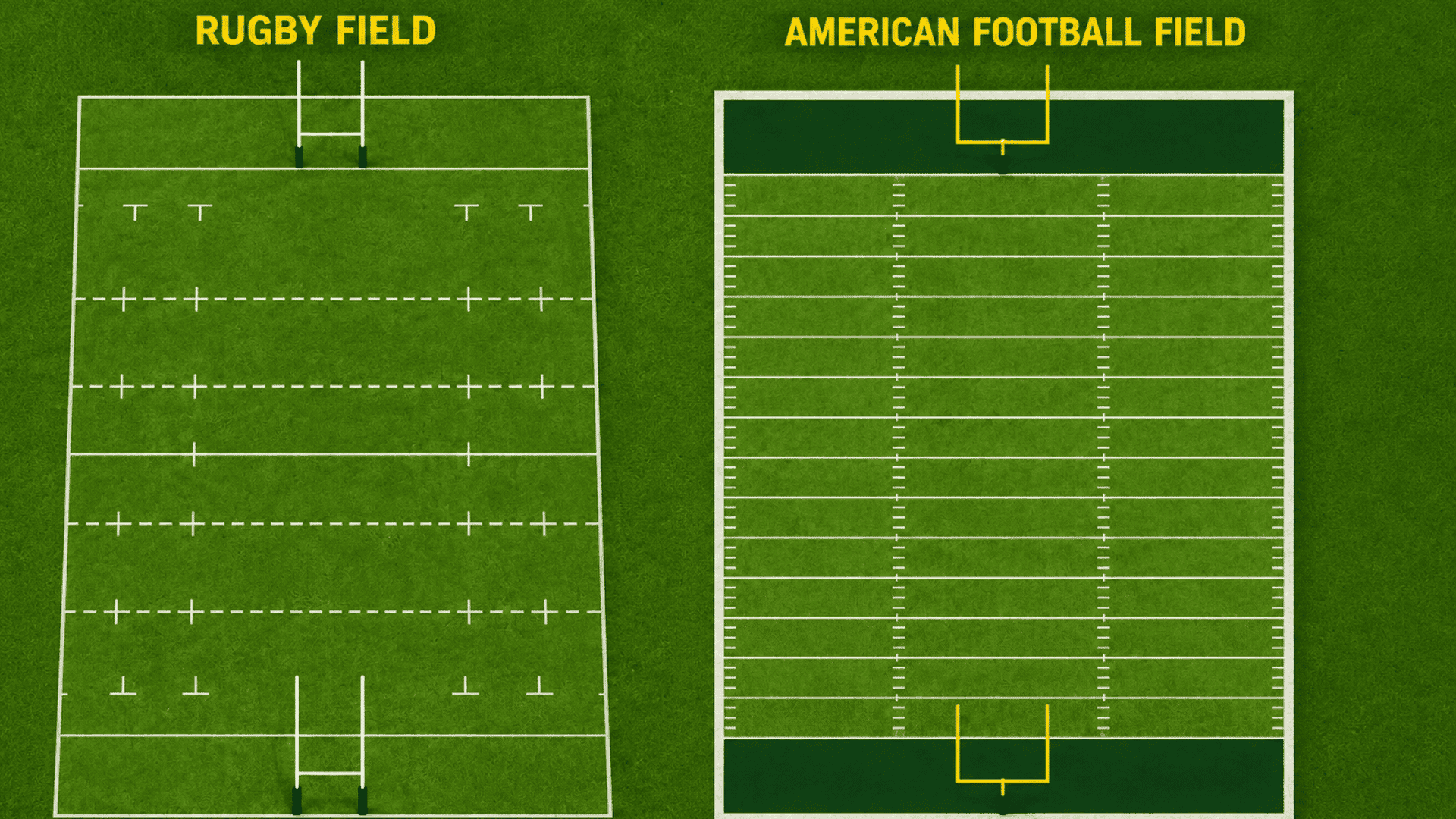
Rugby and American football fields serve the same basic purpose, but their dimensions and markings are different.
A rugby union field is generally longer and wider, with an in-goal area at each end. It uses markings such as the halfway line and 22-meter lines to help manage restarts and field position.
An American football field measures 100 yards between the goal lines, with a 10-yard end zone at each end. Yard lines help teams track progress toward a first down or the end zone.
The goalposts are also positioned differently. Rugby posts stand on the goal line, while NFL goalposts are placed at the back of the end zone.
What Do Rugby and American Football Have in Common?
Despite their different rules, rugby and American football share several basic features because the two sports are historically related.
Both Sports Involve:
- Carrying an oval-shaped ball
- Gaining territory toward the opponent’s scoring area
- Tackling ball carriers
- Kicking during play
- Using goalposts for certain scores
- Competing for field position and possession
American football developed from earlier forms of football played in the 19th century, including rugby-style games. Walter Camp later helped shape American football through rule changes such as the line of scrimmage, downs, and 11-player teams.
“In this lies the backbone to which the entire body of American football is attached,” wrote Walter Camp about the snap from scrimmage.
Today, they still share ideas such as tackling, kicking, and gaining territory, but their rules for passing, possession, substitutions, and restarting play make them clearly different games.
Final Thoughts
When comparing rugby vs American football, the biggest differences come down to gameplay, passing, player numbers, and equipment.
Rugby uses 15 players, features more continuous phases of play, allows backward or sideways hand passes, and uses lighter protective gear.
American football uses 11 players, a system of downs, forward passing, specialized units, and heavier protective equipment.
Both sports still share important features such as tackling, kicking, gaining territory, and scoring at the opponent’s end of the field. The easiest way to tell them apart is to watch what happens after a tackle and how the ball is passed.
Next time you watch either sport, focus on those two moments first.
Which sport do you find easier to understand, rugby or American football? Comment below.
Frequently Asked Questions
Is Rugby Older Than American Football?
Yes. Rugby developed earlier, while American football evolved later from older football forms, including rugby-style games played in the 19th century.
Can You Throw the Ball Forward in Rugby?
No. In rugby union, hand passes must go sideways or backward. Teams move forward mainly by running, support play, or kicking.
Is a Rugby Try the Same as an American Football Touchdown?
Not exactly. Both are major scoring plays, but a rugby try is worth five points, while an American football touchdown is worth six.
Why Does Rugby Have 15 Players but American Football Has 11?
The sports developed under different rule systems. Rugby union uses 15-player teams, while American football is standardized around 11 players per side.
Do Rugby Players Wear Helmets and Pads?
Rugby players do not wear hard helmets or shoulder pads. They may use mouthguards, scrum caps, and limited soft protective padding.