



Learning how to play soccer starts with one simple idea: two teams try to move the ball into the other team’s goal while protecting their own. You do not need advanced skills or a full 11-player team to begin; a ball, a safe space, and a basic grasp of the rules are enough.
Through officiating matches, I have seen how quickly the game makes sense once players understand what they can do, where they should be, and what happens next during play.
This article covers the equipment you need, the main rules, player positions, and how a match flows from attack to defense.
Continue reading to get familiar with basic skills to practice, plus a simple routine for your first soccer session.
How to Play Soccer at a Glance
Soccer is played by two teams trying to score more goals than the other. Players move the ball by passing, dribbling, and shooting, while opponents defend and try to win possession back.
In standard soccer, each team has 11 players. A goal counts only when the whole ball crosses the goal line, and a standard adult match is played in two 45-minute halves.
Whenever possession changes, the team with the ball attacks while the other team defends.
A simple possession might look like this: a defender wins the ball, passes to a midfielder, the midfielder plays it forward, and an attacker shoots at goal. That basic pattern is the heart of how soccer works.
What Basic Soccer Rules Should Beginners Know?
For beginners, a small set of rules is enough to understand what is happening and play with confidence.
Start with team size, match time, handball, scoring, and what happens when the ball goes out. You should also know the basics of offside, fouls, free kicks, and penalties.
Once these rules make sense during play, the smaller details become much easier to understand and remember as you gain experience in real games.
1. Players on a Soccer Team

A standard soccer team can have up to 11 players on the field, and one of them must be the goalkeeper.
The other ten are outfield players, while additional players may be named as substitutes under competition rules. Beginners do not need 22 people to start learning, though.
Youth sessions, recreational matches, and practices can use smaller formats such as 3v3 or 5v5, giving everyone more opportunities to touch the ball.
2. Using Hands in Soccer

Outfield players cannot deliberately handle the ball with the hand or arm. Goalkeepers may use their hands inside their own penalty area, subject to goalkeeper rules.
However, a ball touching a player’s hand or arm is not automatically a foul.
IFAB explains that handball decisions depend on factors such as arm position, movement, and whether the contact was deliberate.
3. Scoring a Goal

A goal counts when the whole ball crosses the goal line between the goalposts and under the crossbar, provided the scoring team has not committed an offense.
Each goal adds one to the team’s score, and the team with more goals wins. Some matches can finish level.
When competition rules require a winner, permitted methods can include extra time or a penalty shootout after the match ends in a draw.
4. Restarts When the Ball Goes Out

The ball is out only after it has wholly crossed a touchline or goal line, whether on the ground or in the air. A ball sitting partly over the line is still in play.
Once it is fully out, the restart depends on which boundary it crossed and, for most boundary restarts, which team touched it last.
The quickest way to remember restarts is to check the line first and then identify who touched the ball last.
| Situation | How Play Restarts |
|---|---|
| Ball crosses the touchline | Throw-in |
| Attacking team touches it last over the goal line | Goal kick |
| Defending team touches it last over the goal line | Corner kick |
These restart rules come from IFAB Laws 15, 16, and 17.
5. Offside Position and Involvement
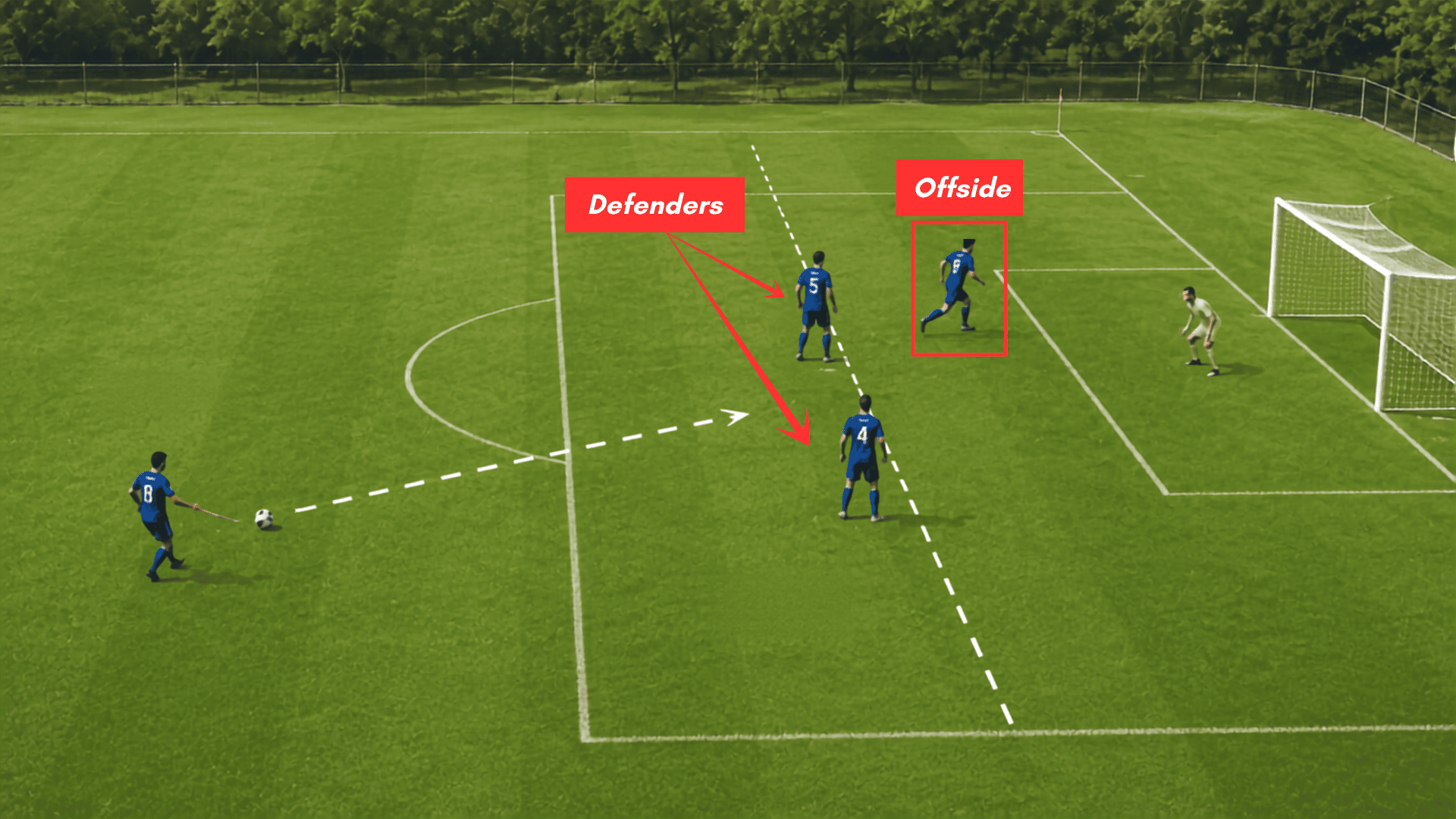

Offside stops attackers from waiting behind most defenders near the goal for a forward pass. A player can be in an offside position without committing an offense; the key moment is when a teammate plays or touches the ball.
The player must then become involved in play to be penalized. There is no offside directly from a throw-in, goal kick, or corner kick.
Simple example! Sam passes forward → Alex is beyond the second-last defender and receives it → Alex may be called offside.
6. Fouls, Free Kicks, and Penalty Kicks

Common fouls include tripping, pushing, kicking an opponent, certain handball offenses, and careless or reckless challenges. Many direct-free-kick fouls outside the defender’s penalty area lead to a free kick.
A direct-free-kick offense by a defender inside their own penalty area can lead to a penalty kick. A yellow card is a caution, while a red card sends the player off.
Tip of the day! Watch where the foul happened as well as what caused it. The location can change the restart the referee awards.
With the basic rules covered, the next step is understanding the main soccer positions and what each player does on the field.
What are the Main Positions in Soccer?
Soccer positions are easiest to understand when you group players by where they usually work on the field. The exact setup changes with the formation, but beginners can focus on four basic roles.
- Goalkeeper: Protects the goal, stops shots, communicates with defenders, and starts play again with throws, passes, or kicks.
- Defenders: Stay closer to their own goal, track attackers, block shots, intercept passes, and move the ball forward after winning possession.
- Midfielders: Connect defense with attack by receiving passes, finding teammates, supporting both areas, and moving into useful space.
- Forwards: Play higher up the field, make attacking runs, create chances, shoot at goal, and pressure opponents after possession is lost.
Once these four roles are clear, formations and more specific position names become much easier to understand.
What Equipment Do You Need to Play Soccer?
You do not need a full match kit to start practicing soccer. A ball, some open space, two markers for a goal, comfortable sports clothing, and shoes suited to the surface are enough for your first sessions.
Organized matches have specific requirements. IFAB Law 4 lists a sleeved shirt, shorts, socks, shin guards, and footwear as compulsory equipment.
Goalkeeper gloves can help with grip and protection, but they are optional under the Laws of the Game.
Here is what equipment you need, when you need it, and what you should know.
| Equipment | When It’s Needed? | Key note |
|---|---|---|
| Soccer ball | In practice and matches | Needed for every type of practice or game |
| Suitable footwear | For practice and matches | Wear shoes appropriate for the playing surface |
| Shin guards | In matches; recommended for practice | Must provide reasonable protection |
| Socks | In matches, sports socks work for practice | Must cover the shin guards |
| Shirt | In matches, sports tops work for practice | Official kit must have sleeves |
| Shorts | In matches, sports shorts work for practice | Part of the compulsory match equipment |
| Goalkeeper gloves | Optional in practice and matches | Useful for goalkeepers but not required by IFAB |
How Does a Soccer Game Work From Kickoff to Final Whistle?
A soccer game is a continuous cycle of gaining the ball, attacking, losing possession, defending, and winning it back. Play starts with a kickoff and restarts the same way after a goal.
From there, each team keeps adjusting to where the ball is and who controls it. For beginners, the easiest way to follow a match is to think in this order:
| Kickoff → Possession → Attack → Taking Possession (Situational) → Restarting (Situational) |
Step 1: The Game Starts With a Kickoff

The ball starts on the center mark after the referee gives the signal. One player kicks it to a teammate, and both teams can then move freely.
Instead of sending the ball straight toward goal, keep the first pass controlled.
Defenders can provide support behind the ball, midfielders can move into passing lanes, and forwards can create space higher up the field.
Step 2: Playing With Possession

A useful beginner pattern is look → pass or dribble → move again. Before receiving the ball, check where teammates and opponents are so you already know your next action.
Avoid crowding around the ball. Teammates should spread out to create passing options and make it harder for defenders to cover everyone.
Simple example: Receive from a defender, look up, play a short pass, then move into new space.
Step 3: Moving Into Attack

As your team moves forward, the focus changes from simply keeping the ball to creating a chance to score.
You might play a forward pass, dribble past a defender, cross from a wide area, or combine with a nearby teammate. Near goal, look at the goalkeeper and available space before shooting.
Other attackers should continue moving so they can receive a pass, reach a rebound, or pull defenders away from the ball.
Step 4: The Other Team Wins Possession (It Depends)

An attack does not always end with a shot. A defender may intercept a pass, make a tackle, collect a loose ball, or have the goalkeeper make a save.
Once the other team takes possession, your roles change immediately. The nearest player can pressure the ball while teammates move back, cover passing options, and track opponents.
The team that just won the ball can now begin its own attack in the opposite direction.
Step 5: The Game Restarts (If There is a Stoppage)

Play restarts whenever a foul is called, the ball goes out, or a goal is scored. The restart depends on what caused the stoppage.
A foul may lead to a free kick or penalty kick, while the ball going out can result in a throw-in, goal kick, or corner kick. After a goal, play starts again with a kickoff from the center mark.
When the other team wins possession, play can change quickly. Depending on the situation, they may build an attack, create a chance, or even score a goal.
Beginner Soccer Skills and Practice Routine
Improve faster by practicing a few core skills in a simple routine, rather than trying to do everything at once.
Focus on first touch, passing, dribbling, shooting, receiving, and basic defending, then combine them in short, game-like exercises.
Try this 25-minute routine to hone your soccer skills, spending about 5 minutes on each activity.
- Start: Dribble through cones using both feet.
- Next: Pass against a wall and control each return.
- Then: Practice receiving the ball and turning into space.
- After that: Take controlled shots at different parts of the goal.
- Finish: Add light defending, movement, or a small-sided game.
Keep the pace comfortable and focus on clean technique. As control improves, gradually add speed, pressure, and more difficult movements.
What Mistakes Should New Soccer Players Avoid?
New soccer players often make the game harder by chasing the ball everywhere, standing too close to teammates, or staying still after passing. These habits reduce space and make it harder for the team to keep possession.
Another common mistake is looking down while dribbling or trying to beat every defender. Keep your head up, look for passing options, and choose a simple pass when it is safer.
When shooting, focus on accuracy before power instead of trying to hit every shot as hard as possible. Beginners should also react quickly after losing possession and recover their position instead of switching off.
Final Say!
Learning soccer becomes much simpler when you focus on the basics one step at a time. Know the main rules, understand what each position is responsible for, and bring the equipment needed for the type of game you are playing.
During a match, watch how possession changes and be ready to switch between attacking and defending.
For practice, work on your first touch, dribbling, passing, receiving, shooting, and basic defending before worrying about advanced moves.
Keep your decisions simple, look up often, move after passing, and give teammates enough space. These habits will help you become more comfortable on the ball and more useful to your team.
Now take what you have learned onto the field. What part of soccer do you want to improve first? Share it in the comments.
Frequently Asked Questions
What Size Soccer Ball Should a Beginner Use?
Most adults and players aged 13 or older use a size 5 soccer ball. Younger players commonly use smaller balls, such as size 3 or 4, because they are easier to control while learning.
How Often Should a Beginner Practice Soccer?
Two or three short practice sessions each week can be enough to build basic control and confidence. Regular 20–30 minute sessions are usually more useful than practicing for several hours only once in a while.
How Long Does It Take to Learn the Basics of Soccer?
A beginner can understand the basic movements and game ideas within a few sessions. Becoming comfortable under pressure takes longer, so focus on steady improvement rather than expecting every skill to feel natural immediately.
Do You Need to be Fit Before You Start Playing Soccer?
You don’t need excellent fitness before you start. Start at a comfortable pace and gradually build stamina through practice, small-sided games, and regular movement as your body adjusts to playing.
How Big is a Soccer Field?
No single field size is used for every soccer match. Soccer field dimensions vary within permitted ranges, while youth and recreational games often use smaller fields suited to the number and age of the players.